Flint: the stone Norfolk built with
Most of Norfolk's older walls are flint because the county has almost no building stone of its own. On a flint house the part that needs looking after is the mortar, which has to be lime.

Most of Norfolk’s older walls are flint because the county sits on chalk and has almost no building stone of its own. Flint was what the plough turned up, the sea washed out of the cliffs and the chalk pits yielded, and builders used it for everything from field walls to the cathedral precinct. If you own a flint house or garden wall, the part that needs looking after is the mortar between the stones, which has to be lime.
Why Norfolk built in flint
Flint forms as hard nodules and bands of silica inside chalk, the silica coming from sponges and other sea creatures of the Cretaceous. Norfolk has chalk under most of it and millions of these nodules. What it lacks is freestone, the limestone or sandstone that can be cut into blocks big enough to build with. The architectural historian Stefan Muthesius wrote that “no place in England was further away from good building stone”. Builders who wanted dressed stone shipped it in, often Caen stone from Normandy, and built the rest of the wall in flint.
Field, beach and mined flint
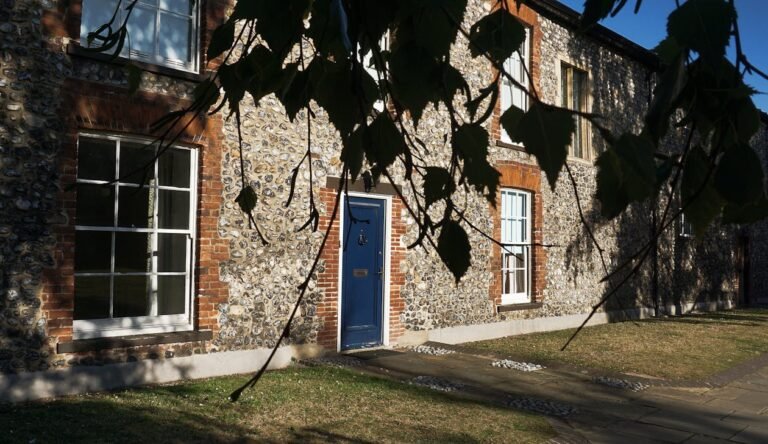
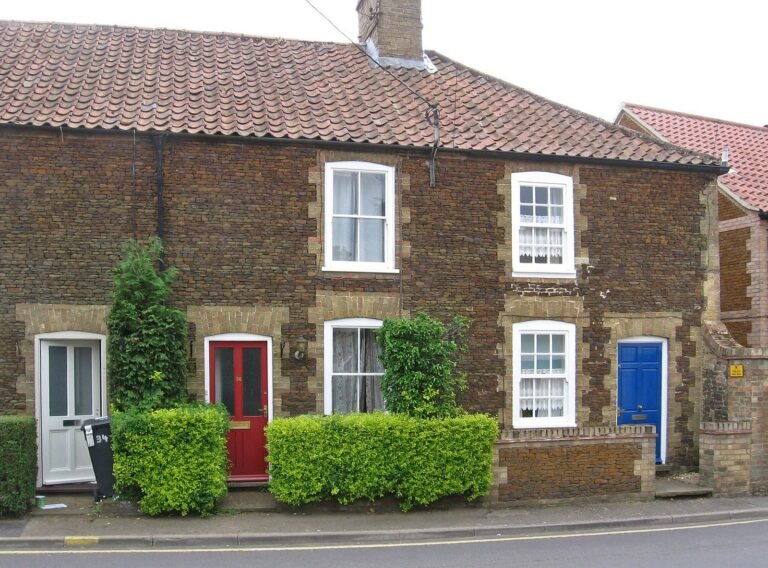
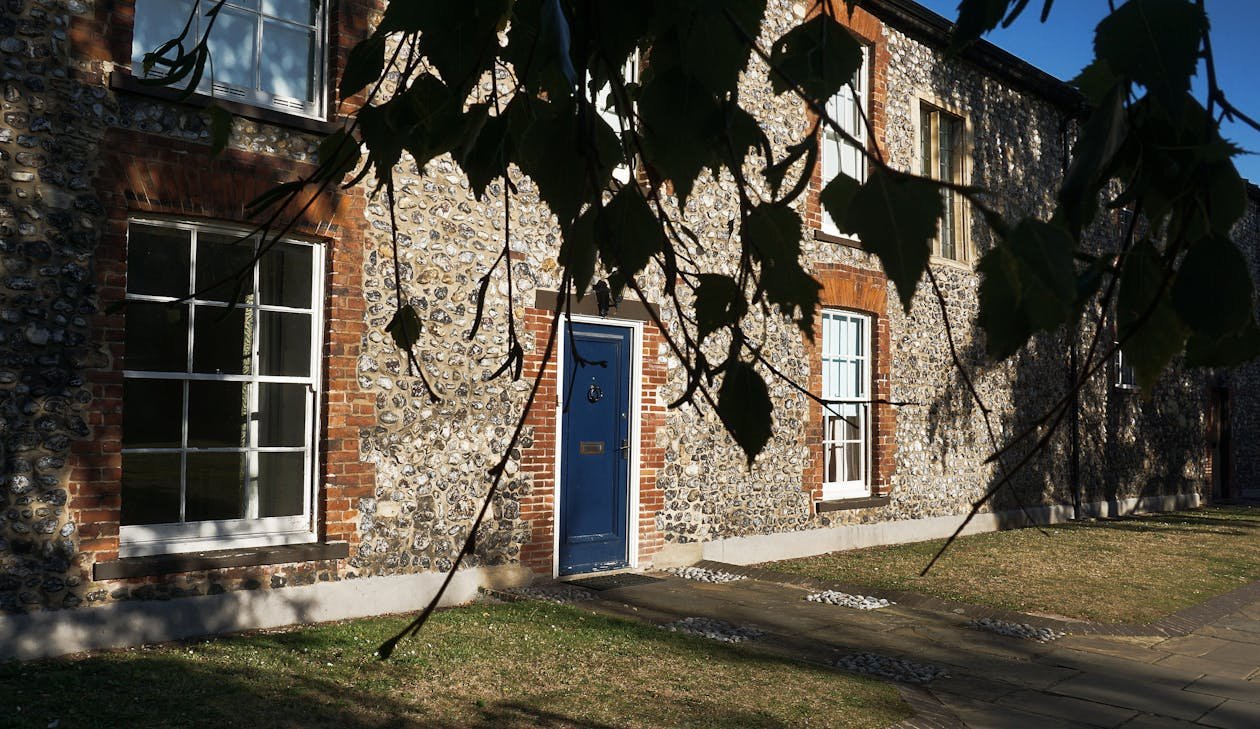
Field flint is what comes up in ploughed ground, weathered out of the chalk or out of the glacial deposits the ice spread across Norfolk. It is irregular, often angular, and sometimes still has a white chalky rind. Most cottage and field walls are built of it.
Beach flint has been rolled by the sea after washing out of the chalk cliffs, so it comes as rounded cobbles and pebbles. It is harder to bond into a wall because the mortar has no edges to grip.
Mined flint was dug from the chalk deliberately. The best-known Norfolk source is Grime’s Graves in the Breckland, three and a half miles from Brandon station, where Neolithic miners began digging around 2600 BC and carried on until about 2100 BC. English Heritage counts 433 mines and pits there. The prize was the layer miners call floorstone, black, glossy and nearly flawless, which could be worked predictably.
Moving to Norfolk this year?
Get the free Norfolk Relocation Pack: all 46 towns we cover on one table, on price, council tax, population, trains and distance to Norwich, plus a week-by-week move checklist. The download appears here as soon as you enter your email.
Unsubscribe any time.
Reading a flint wall
SPAB, the Society for the Protection of Ancient Buildings, notes that flint walls can be roughly dated from their coursing, their mortar and whether the flints were used whole, broken or knapped. Six terms cover most of what an owner will see.
Random rubble is whole or roughly broken flints laid without courses in lime mortar, the oldest and plainest kind. Coursed flint is the same material laid in level rows. Knapped flint has been split on purpose to show the black interior, and knapping, as Heritage Crafts defines it, is shaping flint by striking it to make a flat-faced stone. Square-knapped flint goes a step further: each piece is trimmed to a near-rectangle and laid with fine joints so the wall reads almost like cut stone. The north wall of the Bridewell in Norwich, built around 1370, is squared flint. The word “gauged” belongs to brickwork and is best kept there.
Flushwork is knapped flint set in the same plane as pale dressed limestone so the two make a pattern on the wall. It is an East Anglian speciality. It was at its height on the region’s churches between about 1450 and the 1520s, and the Victorian Gothic Revival brought it back. The Ethelbert Gate into the Norwich Cathedral precinct at Tombland, built between 1316 and 1320, has some of the earliest closely datable flushwork in England. The Norwich Guildhall, built between 1407 and 1412, has chequer panels of it, and the south aisle of St Michael Coslany, added in 1500, is covered in white stone patterns set into black flint.
Galleting is found on cottages more than churches: small chips of flint pushed into the wet mortar of a rubble wall, close enough to form a pattern. In England it is most common in West Sussex and in Norfolk, especially along the north coast. The chips may have saved lime and steadied the wall as well as decorating it; nobody has settled which.
Knapping today
Heritage Crafts’ 2025 Red List of endangered crafts classes flintwork for buildings as Endangered, with between 11 and 20 people earning their main living from it. It gives two reasons: good building flint is scarce in the UK, and concrete blocks with flints pressed into the face now let any bricklayer build a flint-faced wall without the old skill.
The historic centre of the trade is Brandon, just over the Little Ouse in Suffolk, on the same chalk as Grime’s Graves. As well as building flint it knapped gunflints: the industry concentrated there in 1792, supplied the British army through the Napoleonic wars, and declined after the percussion cap arrived in 1835. The skill that shaped gunflints is the one that faced East Anglia’s churches.
Brick and pantiles
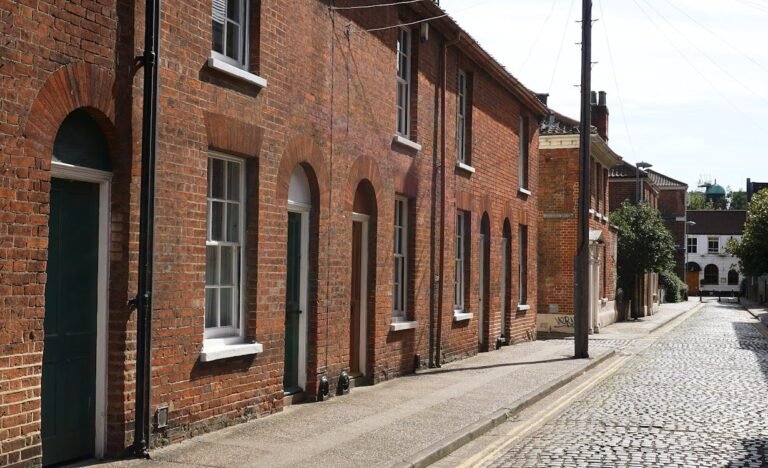
Norfolk was also early to brick. The historian Simon Thurley dates Norfolk brick building to about 1300 and calls it one of the great brick counties of England. Caister Castle was begun in 1432, Oxburgh Hall in 1482, and East Barsham Manor went up in the 1520s. Red brick went on being made across the county into the twentieth century.
On the western edge of Norwich, the Gunton family ran the Costessey brickworks from the 1830s until 1915, making ornamental moulded bricks and terracotta panels sold as “Cosseyware”, after the local way of saying Costessey. You can see it on Victorian buildings in the city, including the Royal Hotel, Bewick House on Thorpe Road and the relief panels of 1896 at 7 London Street, and on the Cliftonville Hotel in Cromer.
Pale cream “Suffolk white” or “Cambridge gault” brick is made from gault, an iron-poor clay that fires without turning red. Norfolk’s own gault is thin, and most gault brick in the county was made in Suffolk or Cambridgeshire.
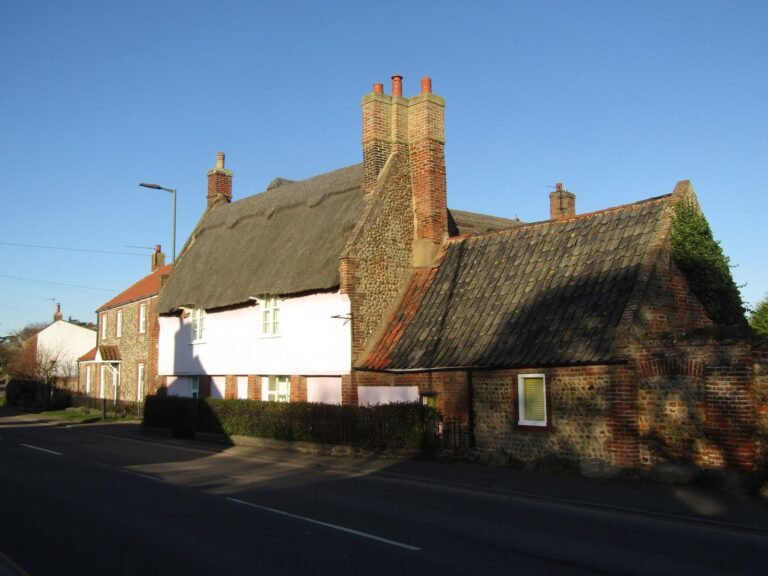
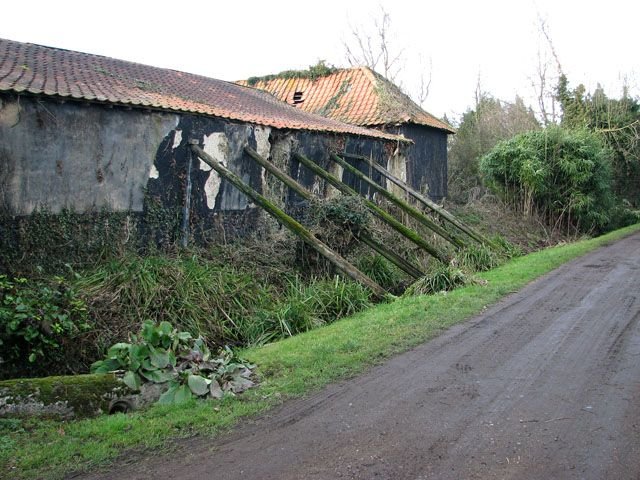
The wavy roof on older Norfolk village buildings is the S-shaped clay pantile, which reached East Anglia through seventeenth-century trade with the Low Countries before English makers took it up. Norfolk also has black-glazed pantiles, red clay with a dark glaze on the exposed face, used where the roof could be seen from the street.
If you own a flint wall
SPAB describes flint as “very hard, impervious”. Water does not pass through the nodules, so all the drying a flint wall does happens through its joints. Lime mortar is porous and lets that moisture out; SPAB’s flint walls advice says lime-based mortars let walls “breathe” and allow fine cracks to heal. Dense cement-rich mortar shrinks as it dries and opens fine cracks that let water in and cause damp inside. Once the joint is the hardest, least permeable part of the wall, SPAB’s advice on cement pointing is that the stones and bricks around it erode instead.
If a builder proposes repointing a flint cottage, garden wall or barn in sand and cement, say no. SPAB’s view is that a non-hydraulic lime may suit repointing flintwork, while rebedding loose flints and copings needs a faster set, from a pozzolan or a natural hydraulic lime, though not a strong one. Our guide to lime mortar and render explains the grades, and the heritage builders directory lists Norfolk firms that work in lime and flint. Ask any contractor which lime they would use on your wall and why.
Common questions
Can I repoint a flint wall in ordinary cement mortar?
No. Flint is impervious, so the wall dries only through its joints, and cement mortar shrinks, cracks and holds water in the wall. SPAB recommends lime-based mortar for flintwork.
What is flushwork?
Knapped flint set in the same plane as pale dressed stone, so the two make a pattern on the wall. It is an East Anglian speciality. The Ethelbert Gate at Norwich Cathedral, built between 1316 and 1320, has some of the earliest closely datable flushwork in England.
Is flint knapping still practised in Norfolk?
Yes, by a small number of people. Heritage Crafts classes flintwork for buildings as Endangered, with 11 to 20 people working at it as their main income. Concrete blocks faced with flint let bricklayers put up flint-faced walls without it.
What is a Cosseyware brick?
An ornamental moulded brick or terracotta panel from the Gunton family’s Costessey brickworks, which ran from the 1830s to 1915; the name follows the local pronunciation of Costessey. There are examples on the Royal Hotel and 7 London Street in Norwich and on the Cliftonville Hotel in Cromer.
Planning a move to Norfolk?
Our guides to hiring the firms a move needs.
We earn no commission on these links. Paid placements are sold separately and always labelled. See our advertising and disclosure page.