All best of norfolk
Norfolk beaches: dog rules, lifeguards and parking at ten beaches
West of Wells the sands are wide and the tide goes out a long way. From Sheringham round to Gorleston there are piers, promenades and, in summer, lifeguards.

The Norfolk Coast Path runs 84 miles from Hunstanton to Hopton-on-Sea, and the beaches along it split roughly in two. West of Wells the sands are wide and the tide goes out a long way and comes back quickly; from Sheringham round to Gorleston there are piers, promenades and, in summer, lifeguards. Below are ten beaches with the dog rules, lifeguard cover, water quality and parking for each.
With small children, Cromer is the easiest choice: a promenade, toilets and cafés, and RNLI lifeguards through the summer. With a dog that needs to run in July, go to Holkham or Brancaster. For quieter sand than the resorts, try Sea Palling, Winterton or East Runton.
Dogs, lifeguards and parking
Each council sets its own dog rules, and the dates differ. North Norfolk District Council restricts dogs on parts of the beaches at Cromer, Sheringham, Sea Palling, Mundesley, Overstrand, Bacton, Walcott and the Runtons from 1 May to 30 September. The King’s Lynn and West Norfolk borough council bans dogs from Hunstanton’s main beach from 1 April to 31 October, a month longer at each end. Great Yarmouth Borough Council’s seasonal controls on the Yarmouth and Gorleston beaches and parts of their promenades run from 1 May to 30 September. Wells and Holkham are run by the Holkham Estate, which has its own rules, given below. Zones are signed on the beach and can change between seasons, so check the signs before you let a dog off.
RNLI lifeguards started daily patrols, 10am to 6pm, on 23 May 2026 at Cromer East, Sheringham West, Mundesley, Sea Palling and Gorleston. Cromer West, East Runton, West Runton, Sheringham East and Wells joined on 11 July, as did Great Yarmouth and Hemsby. Wells, Sheringham East, Cromer West and the two Runtons finished on 6 September, and Sheringham West, Cromer East, Mundesley, Sea Palling and Gorleston on 13 September. Holkham, Brancaster and the two Hunstanton beaches were not on the RNLI’s 2026 list.
The Environment Agency tests designated bathing waters each summer and grades them in four classes. In 2025 Wells, Sheringham, the Runtons, Cromer, Mundesley, Sea Palling, Hemsby, Great Yarmouth and Gorleston were all in the top class; Hunstanton and Old Hunstanton were Good, the second class; Heacham was Sufficient. Holkham and Brancaster are not tested.
Holkham’s Lady Anne’s Drive and the Wells beach car park charge the same: £3.80 for up to two hours, £7.20 for up to four and £14 for the day. Other car parks post their prices at the machine. On warm bank holidays and in the school summer holidays the coastal car parks fill early.
Holkham Beach
Holkham is the beach to choose for space. At low tide the sea can be half an hour’s walk from the entrance on Lady Anne’s Drive, across sand backed by dunes and pine woods on the Holkham National Nature Reserve. There is nothing to buy on the sand. The Lookout, at the entrance, has a café and toilets, and there are more toilets in Holkham village opposite the Adnams shop. In winter, thousands of pink-footed geese feed in the fields either side of Lady Anne’s Drive. There are no lifeguards, the estate warns of strong tidal currents, and Holkham is not one of the Environment Agency’s tested bathing waters.
Dogs are welcome all year. From 1 April to 31 August they must be on leads in the marked nesting areas, which leaves more than 70% of the beach for walking off the lead. Parking is on Lady Anne’s Drive (NR23 1RG). Holkham suits walkers and dog owners better than families who want to sit near the water.
Still deciding where in Norfolk?
Get the free Norfolk Relocation Pack: all 46 towns we cover on one table, on price, council tax, population, trains and distance to Norwich, plus a week-by-week move checklist. The download appears here as soon as you enter your email.
Unsubscribe any time.
Wells-next-the-Sea Beach
The beach at Wells is at the end of Beach Road, north of the town, with a row of coloured beach huts that Pinewoods Holiday Park hires out and the Wells Beach Café by the car park. The harbour railway that once ran down from the town has gone. Since July 2022 a beach bus has covered the route, daily from Easter to October, from the football club car park to Beach Road; the fare is £2 for adults and £1 for under-16s. An electric bus does most of the work, and a 1951 open-top Leyland Tiger joins it on busy days.
Wells had lifeguards in the peak weeks of 2026 and top-class water in 2025. The Holkham Estate keeps a small section at the eastern end dog-free, and asks for dogs on leads near the nesting areas towards Holkham in the breeding season. Wells suits families who want a lifeguarded beach with a café, and anyone without a car in summer.
Cromer Beach
Cromer is the traditional seaside town of the north coast: a pier, a promenade under the cliffs and a beach of shingle and sand. The pier was 125 years old in 2026, and the Pavilion Theatre at its end ran that year’s Pier Show from 27 June to 19 September. The pier’s operators describe it as the only full-season end-of-the-pier show in the world.
Cromer East was one of the first beaches in the county to get lifeguards in 2026, and the district council’s summer dog restriction covers the main beach. Parking is at the Runton Road and Cadogan Road car parks. Cromer is the one to pick with young children in the season.
Sheringham Beach
Sheringham, a few miles west of Cromer, has a promenade with a flint-fronted sea wall and a beach that is mostly shingle, stepping down to sand at low tide. It is smaller and quieter than Cromer, with no pier. Both ends of the beach had lifeguards in 2026, and the water was top class in 2025.
The summer dog restriction applies here too. Parking is at Station Road and Lifeboat Plain. Sheringham suits swimmers who do not mind a pebble entry and walkers heading along the cliffs towards the Runtons.
Hunstanton Beach
Hunstanton faces west across the Wash, so the sun sets over the sea, which is unusual on the east coast of England. Its cliffs are striped in three bands: red-brown carrstone at the base, red chalk above it and white chalk at the top. The Geological Society lists them among its 100 Great Geosites. They are best seen from the beach at low tide, and they are not for climbing. The promenade has amusement arcades and chip shops; this is a resort town.
The dog ban runs from the power boat ramp to the northern end of the promenade, and on the promenade itself dogs must be kept on leads over the same months. The main beach’s water was in the second of the four classes, Good, in 2025, and it was not on the RNLI’s 2026 lifeguard list. Parking is at the Southend car park. Hunstanton suits families who want a resort with facilities, and dog owners outside the April to October ban.
Old Hunstanton Beach
A mile north of the resort, Old Hunstanton has the same cliffs without the arcades, with dunes behind the beach, the lighthouse above it and the golf course towards Holme-next-the-Sea. The council’s dog ban covers only the main Hunstanton beach, not this one. Its water was also graded Good in 2025. Parking is on Beach Road, Old Hunstanton, and the spaces go early in summer. It suits dog walkers and anyone who wants the Hunstanton cliffs without the town.
Brancaster Beach
Brancaster is a National Trust beach where the sand runs a long way out at low tide and the water comes back fast, filling the creeks behind the sandbanks. Do not walk out to the wreck of the SS Vina. The ship grounded here in 1944, lies about 800 metres off the main beach and is exposed at low water on an area called Wreck Sands, which the incoming tide cuts off quickly. On 17 August 2024 a 74-year-old man died after being caught by the tide on his way out to the wreck.
Dogs are allowed on the beach all year. There are no lifeguards, and Brancaster is not a tested bathing water. The beach car park is pay and display. Check the tide tables before every visit. Brancaster suits experienced walkers and sailors who know the tide; it is the wrong beach for a casual stroll out to the sandbanks.
Great Yarmouth Beach
Great Yarmouth has a mile of east-facing sand along Marine Parade, the Golden Mile, with the beach running on north towards Caister and south towards Gorleston. Behind it is the Pleasure Beach, whose wooden Scenic Railway opened there in 1932. Historic England lists it at Grade II; it is the only scenic railway still running in Britain and one of seven in the world, and a brakesperson rides each car because there are no brakes on the track. The seafront has arcades and fish and chips all along it.
Lifeguards arrived for the school holidays, and all three of the town’s tested stretches, North, Pier and South, were in the top class in 2025. The council’s seasonal dog controls cover parts of the beach and promenade. Parking is in the Marine Parade car parks. It suits families who want the funfair and the pier as much as the sea.
Sea Palling Beach
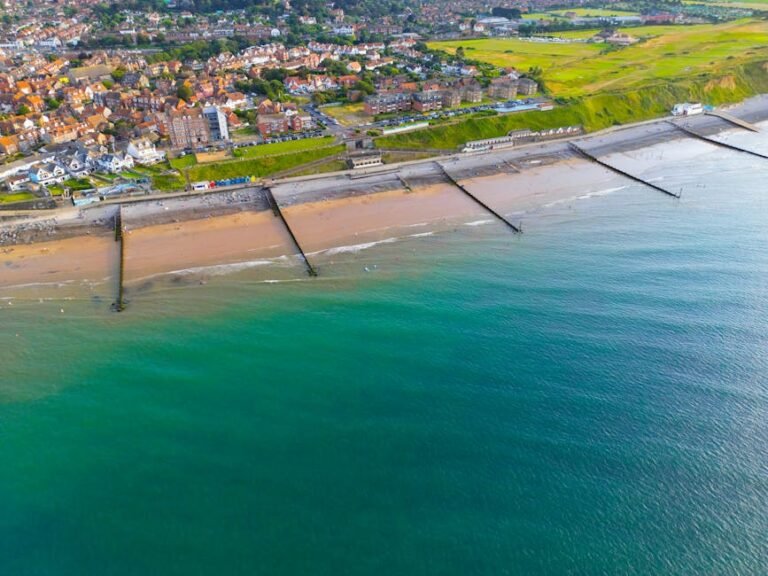
Sea Palling has a long stretch of sand protected by nine offshore reef breakwaters, which also make bays of calmer water between the rocks. The reefs came after the North Sea flood of 1953, which killed seven people in the village; four were built by 1995 as part of a multi-million-pound sea defence scheme, and five more followed later that decade. The village behind the beach is small, so parking and the chip-shop queues stay manageable.
Sea Palling was lifeguarded for the whole 2026 season and its water was top class in 2025. In summer dogs are kept off the main beach and on leads on the promenade. Parking is at the Sea Palling beach car park. It suits families from the east of the county who find Yarmouth too busy.
Gorleston-on-Sea Beach
Gorleston’s beach is a wide, curving bay of sand south of the harbour mouth, backed by a promenade and the Pavilion, which opened in 1901. The Pier Hotel at the harbour’s mouth, completed in 1897, looks over the boats going in and out of Great Yarmouth. Tripadvisor’s Travellers’ Choice awards named Gorleston the best beach in the UK in 2023.
Gorleston was patrolled every day of the season, and its water was top class in 2025. In the summer months dogs must be on leads on the promenade between the breakwater and the Ravine, and the council’s seasonal beach controls apply. Parking is at the Gorleston Cliff car park. Gorleston-on-Sea suits swimmers and families who want Yarmouth’s water and lifeguards with a quieter seafront.
Beach safety on the Norfolk coast
On the north coast the beaches are so flat that low and high water can be hundreds of metres apart, and the tide at Holkham and Brancaster can cut you off faster than it looks from the shore. Check the tide tables for Norfolk before you go, carry a charged phone, and if someone gets into difficulty call 999 and ask for the Coastguard.
People have drowned in tidal incidents on this coast, including at Brancaster in August 2024, where a visitor was cut off by the incoming tide on the walk out to the Vina. The risk comes from how far out you can walk at low water and how fast the tide returns. Plan the walk back before you set out.
Frequently asked questions
What is the best beach in Norfolk?
For most people, Holkham, for the space and the walk. Cromer is better for a pier, a promenade and lifeguards, and Wells-next-the-Sea for a lifeguarded beach with a café and beach huts. Brancaster and Old Hunstanton are quieter, but Brancaster’s tides need respect.
Are Norfolk beaches sandy?
Most are. The north coast from Hunstanton to Wells has wide sand at low tide, and Sea Palling, Great Yarmouth and Gorleston are sandy on the east coast. Cromer and Sheringham have shingle at the top of the beach and sand lower down.
Are Norfolk beaches good for families?
Several had RNLI lifeguards in summer 2026, including Cromer, Sheringham, Wells, Sea Palling, Great Yarmouth and Gorleston. Holkham and Brancaster have more space but no lifeguards and few facilities.
Can you swim in the sea in Norfolk?
Yes. In 2025 the Environment Agency put the bathing water at Wells, Sheringham, Cromer, Sea Palling, Great Yarmouth and Gorleston in its top class, and Hunstanton and Old Hunstanton in the second, Good. Swim where lifeguards are on duty, between the red and yellow flags, and check the tide first.
Which Norfolk beaches allow dogs in summer?
Holkham and Brancaster allow dogs all year, though Holkham asks for leads in its nesting areas from 1 April to 31 August, and the council order at Hunstanton does not cover Old Hunstanton. The resort beaches restrict dogs from 1 May to 30 September in North Norfolk and at Great Yarmouth and Gorleston, and from 1 April to 31 October at Hunstanton.
Related guides
- Living in Cromer, Norfolk
- Living in Sheringham, Norfolk
- Living in Wells-next-the-Sea, Norfolk
- Living in Hunstanton, Norfolk
- Cromer vs Sheringham
- Hunstanton vs Cromer: west coast vs east coast
Plan the move
How we produced this guide
Dog rules come from the public spaces protection orders published by North Norfolk District Council and West Norfolk’s borough council, from Great Yarmouth Borough Council’s order as reported locally, and from the Holkham Estate’s own beach pages. Lifeguard dates are from the RNLI’s 2026 announcements. Bathing water ratings are the Environment Agency’s 2025 classifications. Parking charges for Holkham and Wells are from the Holkham Estate. Tide safety advice follows HM Coastguard’s. We update this guide each season. See our methodology page for source links.
Data sources: council dog orders (NNDC, KLWNBC, Great Yarmouth BC), Holkham Estate, RNLI, Environment Agency, National Trust. Period covered: 2026 season. Author: Sarah Ellis, Coast and Lifestyle Editor.
Last reviewed
Planning a move to Norfolk?
Our guides to hiring the firms a move needs.
We earn no commission on these links. Paid placements are sold separately and always labelled. See our advertising and disclosure page.