Traditional Norfolk buildings: what the county is made of
Norfolk's older buildings are made of what was in the ground or growing nearby: flint, carrstone, clay lump and reed. Their solid walls stay sound only if they can dry out through lime.

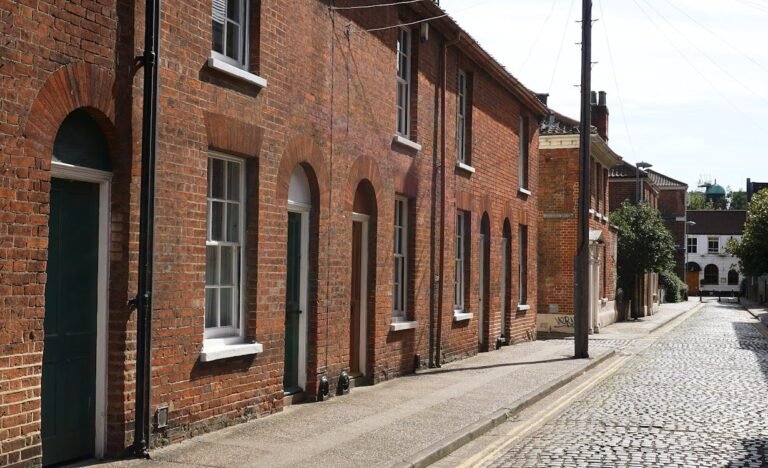
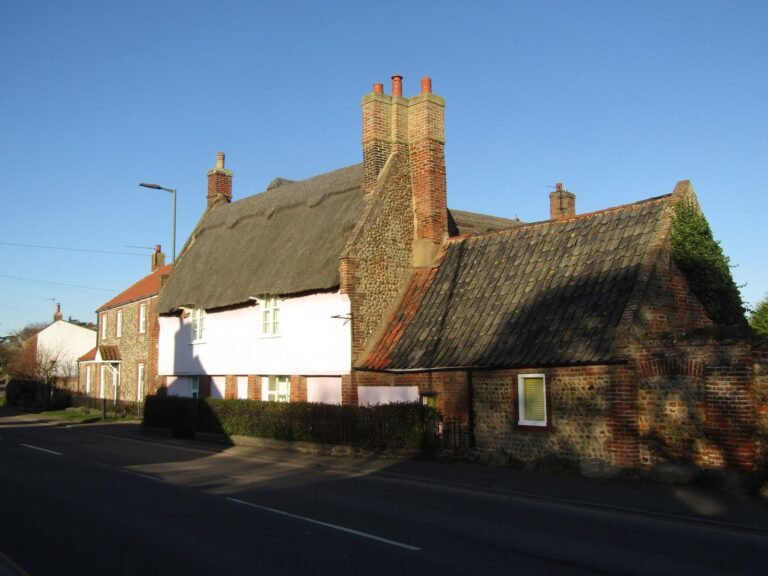
Norfolk’s older buildings are made of whatever was in the ground or growing nearby. Across most of the county that meant flint from the chalk. On the western edge, in a narrow strip, builders used carrstone, a rust-brown sandstone, and on the southern claylands they moulded the subsoil itself into big blocks of clay lump. Many roofs were thatched with reed cut in the fens of the Broads. The county had almost no stone that could be cut into building blocks; the architectural historian Stefan Muthesius wrote that “no place in England was further away from good building stone”. So what you see on an old Norfolk street tells you, roughly, what is under it.
The walls have one thing in common. They are solid, with no cavity, and they stay sound by letting moisture soak in and dry back out through the mortar, render and wash on their surface. All of those were traditionally lime. Cement render and cement pointing trap the water in, which is why the first thing to check on any old house you are thinking of buying is what its walls have been pointed and rendered with.
Flint
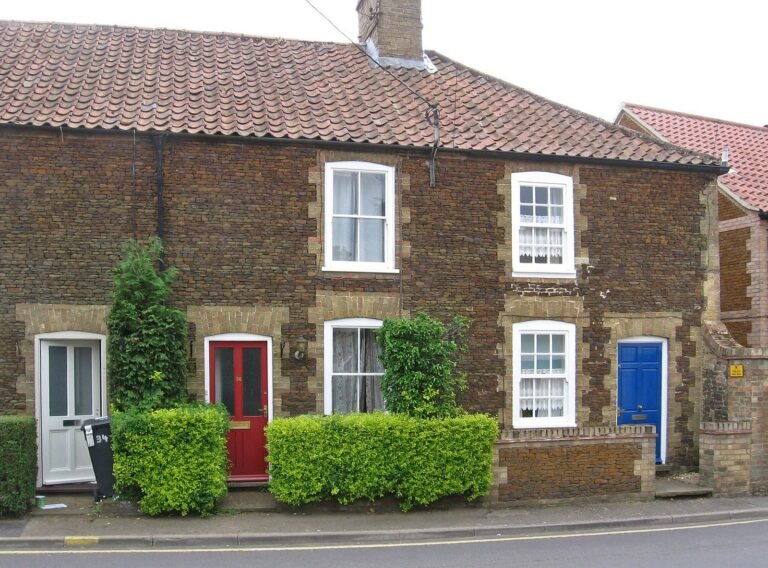
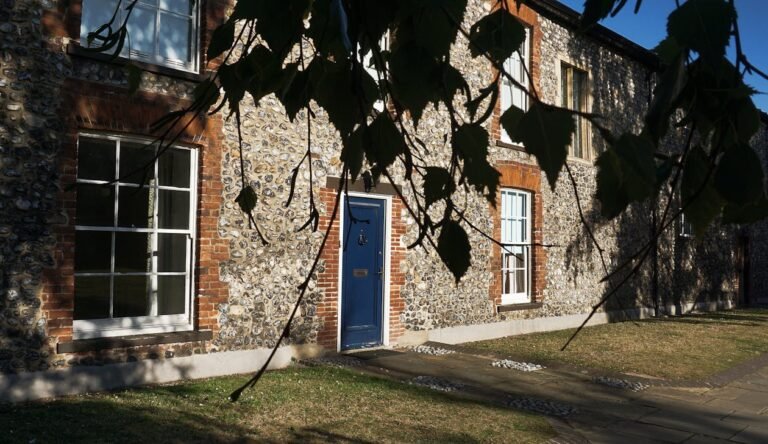
Most older Norfolk walls are flint. It is field flint turned up by the plough, beach flint rounded by the sea, or mined flint dug from the chalk, the best-known source being the Neolithic mines at Grime’s Graves in the Brecks. The walls range from random rubble, whole flints laid in lime without courses, to knapped flint split to show its black face, square-knapped flint trimmed almost to blocks, and flushwork, where knapped flint is set flush with pale limestone to make patterns. The Ethelbert Gate at Norwich Cathedral, built between 1316 and 1320, has some of the earliest closely datable flushwork in England. Most houses are rubble or coursed flint; the finer work is mostly on churches. Heritage Crafts lists flintwork for buildings as an endangered craft, so the pool of people who can repair it well is small. The flint page has the full vocabulary, plus Norfolk brick, Cosseyware and the county’s black-glazed pantiles.
Clay lump
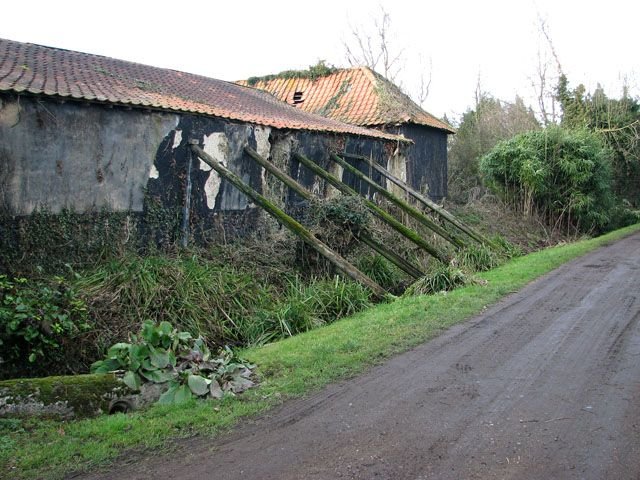
Clay lump is unfired earth: clay-rich subsoil mixed with chopped straw, pressed into wooden moulds, dried, and laid in courses like oversized bricks, usually with a render over the top so that you cannot see what the wall is made of. Dirk Bouwens, writing in the Building Conservation Directory in 1997, placed it in East Anglia east of the A1 and south of the A47, and described it as the main walling material for every sort of building on the chalky boulder clays of Norfolk and Suffolk for about 100 years from around 1800. Its rise overlaps with the Brick Tax, which ran from 1784 to 1850 and did not apply to unfired blocks. In Norfolk that means the south, on the claylands toward the Suffolk border. The sandy Brecks around Thetford have no clay for it, and flint is the local walling there. Clay lump is the material most easily ruined by cement render. The clay lump page covers how to recognise it and what it means for a mortgage and insurance.
Moving to Norfolk this year?
Get the free Norfolk Relocation Pack: all 46 towns we cover on one table, on price, council tax, population, trains and distance to Norwich, plus a week-by-week move checklist. The download appears here as soon as you enter your email.
Unsubscribe any time.
Carrstone
In the far west the walls turn ginger. Carrstone is an iron-rich sandstone which the British Geological Survey records as the Carstone Formation: generally about 5 metres thick, and 18.9 metres at most, in a borehole at Hunstanton, where the stone forms the base of the cliffs. Because the bed is thin, carrstone country is a strip, running south from Hunstanton through Snettisham, Sandringham and Castle Rising to Downham Market, whose carrstone buildings earned it the name the Gingerbread Town. Carrstone walls are often galleted: small chips of carrstone pressed into the lime mortar between the blocks. The carrstone page covers the ways it was laid, the Hunstanton cliffs and where to find stone for repairs.
Norfolk reed
“Norfolk reed” is water reed, the wetland grass Phragmites australis, and a Norfolk reed roof is not necessarily made of reed from Norfolk: Historic England puts imported reed at around 97% of the water reed used in England. Cutters still harvest it in the Broads each winter. Many belong to the Broads Reed and Sedge Cutters Association. Water reed cannot be patched with a new top coat the way straw can, so when a reed roof is worn out the old thatch comes off down to the timbers. Insurance is a specialist market. Fire is the main risk to plan for. The thatch page covers the cutting, the steep East Anglian roof pitch, how long a roof lasts and what listed building consent involves.
Lime
Solid walls built before about 1919, whether flint, soft brick, carrstone or clay lump, dry out through their surface, and the Society for the Protection of Ancient Buildings (SPAB) warns that impervious cement render restricts that evaporation and can cause major structural damage to earth walls. On brick and stone, cement pointing that is harder than the masonry makes the bricks and stones erode instead of the joint. Water cannot pass through flint at all. On a flint wall the joints are the only way out. Limewash belongs over lime render, lime plaster and earth walls, and SPAB says it is unsuitable on flint. The lime page explains the types of lime, when to do the work, the rising damp diagnoses to be wary of, and what to ask a builder.
Buying or repairing
If you are buying, our guide to buying a period or non-standard home in Norfolk covers the survey to ask for, listing, mortgages and insurance. If you already own one, the heritage builders directory lists lime builders, conservation surveyors, thatchers and flint and stone contractors working in the county.
Planning a move to Norfolk?
Our guides to hiring the firms a move needs.
We earn no commission on these links. Paid placements are sold separately and always labelled. See our advertising and disclosure page.