All practical guides

Can you live on a boat on the Norfolk Broads? A guide to residential moorings
On the whole 125 miles of navigable water, there are around ten authorised residential moorings. What the Broads Authority allows, where the plots are, and the council-tax and finance rules.

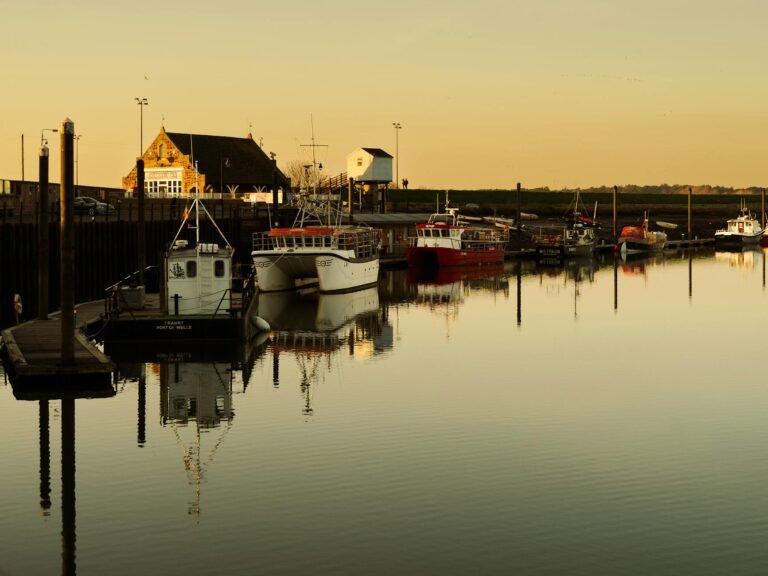
People ask us this often enough that it is worth answering carefully. Yes, you can live on a boat on the Norfolk Broads, and a small number of people do. But the paperwork, the planning rules and the physical reality are not what most inquirers expect. The limiting factor is not whether a boat can be a home, but where the Broads Authority will let you keep one as one.
The short version: on the whole 125 miles of navigable water, there are around ten authorised residential moorings. The Broads Authority’s own 2019 note on residential moorings gives the figure. The Local Plan review proposes adding roughly fifty more across six named marinas, but by early 2026 only one of those allocations had submitted a planning application. Supply is the whole story.
What makes a mooring “residential”
A residential mooring is a mooring where a boat is someone’s sole or main home. That matters because residential use is a material change of use under planning law. The Broads Authority is the local planning authority for the executive area, and its Residential Moorings Guide (July 2021) is the document a prospective applicant has to work through.
A boat moored in a marina with a berth let for leisure use, visited at weekends and lived in briefly in summer, is not a residential mooring. The owner is a leisure user who happens to sleep aboard sometimes. The planning point is reached when the boat becomes the person’s principal residence and the mooring supports that use permanently. At that point planning permission is required.
Most boatyards and marinas on the Broads do not have residential consent. The ones that do, or that are proposed to, are small in number.
Where authorised residential moorings exist
The Broads Local Plan review names six sites with proposed residential allocations:
- Brundall Gardens Marina (2 small plus 6 large plots proposed)
- Greenway Marine, Chedgrave (5)
- Hipperson’s Boatyard, Gillingham (5)
- Loddon Marina (10)
- Somerleyton Marina (15)
- Richardson’s Boatyard, Stalham Staithe (10)
These are allocations in the draft plan, not open berths. According to the Somerleyton Estate’s examination response document, Somerleyton is the only allocation with an active planning application, and that application is for a first phase of nine moorings against the fifteen-plot allocation. Everything else is on paper. If you want a residential mooring today you are talking to a handful of existing berth holders, usually with waiting lists, or you are looking at a site that has gone through planning permission privately and is not on the Local Plan list at all.
Which is why most people who ask us about this end up looking at the Norfolk waterside house market instead. Living in a Broads village and keeping a boat is far easier to arrange than living on the boat.
Moving to Norfolk this year?
Get the free Norfolk Relocation Pack: all 46 towns we cover on one table, on price, council tax, population, trains and distance to Norwich, plus a week-by-week move checklist. The download appears here as soon as you enter your email.
Unsubscribe any time.
Tolls, registration and what counts as “kept here”
Every vessel kept or used on the Broads for more than 28 days a year has to be registered with the Broads Authority. Registration itself is free. The money part is the annual navigation toll, which is set by vessel type and size and published on the Authority’s current schedule of tolls.
For 2026/27 the Authority raised tolls by 3.5% at its meeting on 28 November 2025. The schedule includes a houseboat category; there is no distinct “liveaboard” toll. Late payment attracts an administration charge at the Notice of Contravention stage and a further charge if a second letter is required, with the figures set out in the Authority’s tolls-enforcement note. About 11,000 boats are registered in total.
None of that confers any right to live on a boat. The toll is a navigation charge; residential use is governed separately through planning.
Why continuous cruising is not the answer
On the inland canal network, Canal & River Trust runs a continuous-cruiser licence that allows people to live on a boat without a home mooring, provided they move every fourteen days. The Broads are not part of that network. They are managed by the Broads Authority under the Norfolk and Suffolk Broads Act 1988 and operate under different rules.
The Authority maintains a network of free 24-hour moorings around the system. The rule is 24 hours unless signage says otherwise, and signs commonly do say otherwise at busy spots. There is no published Broads equivalent of the CRT continuous-cruiser status. The Residential Boat Owners’ Association notes that itinerant users who respect the time limits are generally left alone, but it is advocacy guidance rather than a regulator’s rule. If a liveaboard arrangement on the Broads depends on rotating between free 24-hour moorings, it depends on the Authority’s forbearance, not on a legal right.
Council tax, business rates and the Valuation Office Agency
Once a mooring is residential, council tax follows. The Valuation Office Agency’s rating manual is explicit: a mooring is domestic property, and so attracts council tax rather than business rates, when it is occupied by a boat which is the sole or main residence of an individual. In that case the VOA bands the boat and the mooring together as the dwelling, under the same scheme that bands houses. The relevant guidance sits in the Valuation Office Agency’s practice note on the application of council tax to caravan pitches and moorings.
A leisure berth is different. If the occupation is non-exclusive and insufficiently permanent (a cruiser rented a berth for the summer, say), the boat is not a dwelling for council tax purposes and the owner is not liable. The marina as a business may be rateable at the non-domestic end, but the boater is not paying council tax on their holiday arrangement.
Mortgages and insurance
A high street residential mortgage will not lend against a floating home. Boats are chattels, not land, and the usual security does not apply. People who buy houseboats or long-stay boats use marine finance from specialist lenders. UK names active in that market include Promarine Finance (a direct lender), Pegasus Marine Finance (a broker working with partner lenders) and Shawbrook’s marine finance arm. Deposits are typically higher than for a house (20 to 30 per cent is routine) and terms are shorter, in the order of ten years rather than twenty-five.
One lender takes a different approach. Ecology Building Society will lend on land that has planning consent for a mooring, from £7,000 to £500,000 over ten to twenty-five years. That is a mortgage on the mooring plot, not on the boat.
Houseboat insurance is a specialist product and worth getting quoted independently; general boat insurance written for a leisure cruiser will not usually cover residential use.
Winter on the water
The southern Broads (the Yare, the Waveney, and the Bure below Acle) are tidal, and the Great Yarmouth surge feeds back up the system. The Broads Authority issues autumn and winter safety reminders every year. The Environment Agency flood-warning service is the authoritative live source during a surge event; a liveaboard needs to be set up to read it.
The practical questions are the ones that only matter when the boat is a home: shore power contracts in winter, mains water that will not freeze, waste tank services that keep running out of season, access to the mooring down an unlit footpath after dark in January. Hire operators run winter cruising, which proves it can be done, but they are not living aboard in February and they would not pretend otherwise.
How many people do this
No one publishes an accurate number for liveaboards on the Norfolk Broads. The Broads Authority counts boats, not residences. The 2021 Census records 0.4 per cent of households in England and Wales (around 104,000) as living “in a caravan, or other mobile or temporary structure”, a bucket that mixes houseboats, caravans and park homes together. The Broads-specific figure is almost certainly in the low hundreds at most and likely well below that, but the honest answer is that no primary dataset separates it out.
Who this suits
In practice, the people living afloat on the Broads successfully are either long-standing berth holders at a marina that quietly carries residential consent, retirees who have downsized into a houseboat on an authorised plot after years of planning and queueing, or boat owners whose main residence is elsewhere and whose “liveaboard” is more weekend-and-summer than year-round. Someone arriving fresh with a view that the Broads are the English equivalent of the Dutch grachtenwoningen or the London canals is likely to find a lot of locked gates.
If the appeal is the water and the quiet and the right to a slow life, the easier route is to buy a cottage in Brundall, Horning, Wroxham, Reedham or Loddon, keep a boat at a leisure berth, and spend as much of the summer afloat as you want. We cover living near the Norfolk Broads, including the villages that most people end up in, and the Brundall and Wroxham comparison covers the two obvious anchor villages.
FAQ
Is there a 14-day rule on the Broads?
No. The 14-day rule is a Canal & River Trust rule for the inland canal network. On the Broads, Broads Authority moorings are 24 hours unless signed otherwise. There is no published continuous-cruiser status.
Do I need planning permission to live on my boat?
Yes, if the mooring is to be a residential mooring. Residential use is a material change of use from leisure. The Broads Authority is the planning authority and the Residential Moorings Guide is the starting document.
Do I pay council tax on a houseboat?
If the boat is your sole or main residence and the mooring supports that use, yes. The Valuation Office Agency bands the boat and the mooring together as the dwelling. A leisure berth with a cruiser is not a dwelling for council tax.
Can I get a mortgage on a houseboat?
Not a standard residential mortgage. Marine finance from specialist lenders (Promarine, Pegasus, Shawbrook) is the usual route, with higher deposits and shorter terms. Ecology Building Society will lend on a mooring plot with planning consent.
How many authorised residential moorings are there?
Around ten across the whole Broads, per the Authority’s 2019 note. The Local Plan review proposes adding roughly fifty more across six named marinas, but only one of those (Somerleyton) is actively pursuing a planning application.
Can I live on a boat on the Broads in winter?
In theory, yes. In practice you need an authorised mooring with shore power and services that work in cold weather, and you need to read Environment Agency flood warnings during tidal surges on the southern Broads. The Broads Authority issues autumn and winter safety reminders.
What’s the easier alternative?
Buy a cottage in a Broads village and keep a boat at a leisure berth.
Planning a move to Norfolk?
Our guides to hiring the firms a move needs.
We earn no commission on these links. Paid placements are sold separately and always labelled. See our advertising and disclosure page.