All practical guides

Norfolk or Suffolk: choosing by the move you are making
The choice turns on how often you need to be in London and whether you want to live near water. Suffolk's main line is faster; Norfolk has the Broads, the longer coast and lower prices.

The county you should pick depends mostly on two things: how often you need to be in London, and whether you want to live near water. Suffolk’s main line gets you to Liverpool Street faster. Norfolk has the Broads, the longer coast and the bigger city, and its average house price is about 4% lower. This page works through the choice by the kind of move you are making. For the full side-by-side figures, including rail fares and district prices, see our Norfolk vs Suffolk comparison.
House prices
The HM Land Registry UK House Price Index for July 2026 put the average price at £269,185 in Norfolk and £280,742 in Suffolk. The £11,557 gap is too small to decide a move on its own. The district matters more than the county: averages run from £224,323 in Norwich and £221,445 in Ipswich to £330,523 in Babergh, on Suffolk’s border with Essex.
If you will commute to London
Choose Suffolk, and a town on the main line. On a weekday morning in late September 2026 the fastest Ipswich train reached London Liverpool Street in an hour, and the others before 9am took 1 hour 12 to 1 hour 17 minutes. From Norwich the fastest took 1 hour 39 minutes and most trains 1 hour 47. Two or three days a week, that difference is several hours.
Norfolk has two partial answers. Diss, on the same line just north of the Suffolk border, was 1 hour 22 minutes at best that morning and 1 hour 30 as a rule. In the west, King’s Lynn has an hourly Great Northern service to King’s Cross; the fastest train takes 1 hour 47 minutes and most 1 hour 51 to 1 hour 58.
Moving to Norfolk this year?
Get the free Norfolk Relocation Pack: all 46 towns we cover on one table, on price, council tax, population, trains and distance to Norwich, plus a week-by-week move checklist. The download appears here as soon as you enter your email.
Unsubscribe any time.
If the job is in Norwich or Ipswich
Norwich is the larger city: the ONS counted 200,770 people in its built-up area at the 2021 Census, against 151,565 in Ipswich’s. Norwich has two universities, the University of East Anglia and Norwich University of the Arts, and the Norfolk and Norwich University Hospital. Ipswich has the University of Suffolk and the hour to London.
Local lines matter if you want to live outside the city without driving to every train. From Norwich, the Bittern Line runs to Cromer and Sheringham, the Wherry Lines to Great Yarmouth and Lowestoft, and the Breckland Line through Thetford to Cambridge. From Ipswich, the East Suffolk Line runs up the coast side of the county to Lowestoft, a branch goes to Felixstowe, and trains run west through Stowmarket and Bury St Edmunds to Cambridge and Peterborough.
If you are moving for the coast
Norfolk has more of it. The Norfolk Coast Path runs 112 miles, from the Lincolnshire border to the Suffolk border, past the marshes at Snettisham, Wells, Blakeney and Cromer and down to Great Yarmouth and Gorleston. Much of the north coast is in the Norfolk Coast National Landscape, the former Area of Outstanding Natural Beauty. Suffolk’s equivalent, the Suffolk & Essex Coast & Heaths National Landscape, runs from Kessingland south to the Stour estuary in north Essex and takes in Southwold, Aldeburgh’s shingle, Orford Ness and the Deben and Alde estuaries.
Suffolk’s coast has something Norfolk’s does not: a nuclear power station. Sizewell B operates near Leiston, and Sizewell C, next to it, reached its final investment decision on 22 July 2025 and expects to employ 10,000 people at the peak of construction. If you are looking between Southwold and Aldeburgh, read its traffic and workforce plans first.
For older buyers the nearest hospital matters. Norfolk has three district general hospitals: the Norfolk and Norwich, the Queen Elizabeth in King’s Lynn and the James Paget at Gorleston, which also serves Lowestoft and Waveney. The King’s Lynn and Gorleston hospitals are both due to be replaced: the James Paget’s new building is scheduled to start in 2027-28, and the new Queen Elizabeth is expected to open to patients in 2033. Suffolk’s are Ipswich Hospital and West Suffolk Hospital at Bury St Edmunds.
If you want to live by the water
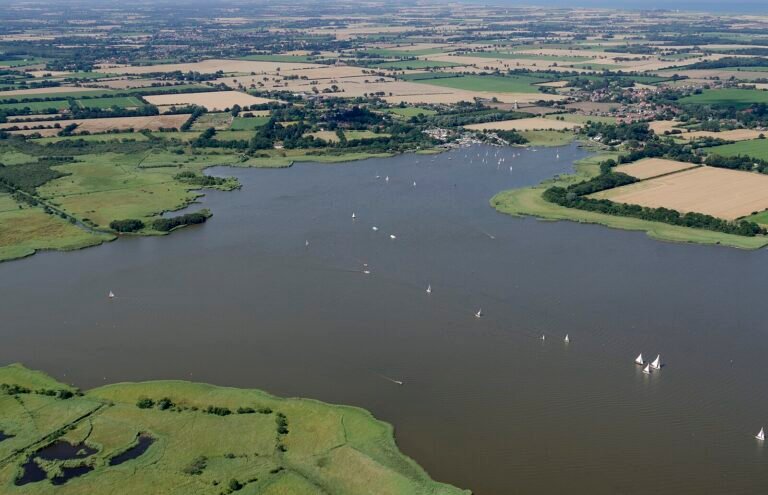
This is a Norfolk answer. The Broads are Britain’s largest protected wetland: seven rivers, more than 60 broads, and more than 125 miles of navigable water. Most of it is in Norfolk; the Suffolk end is around Oulton Broad, by Lowestoft. If you want a mooring within reach of home, start in the Broads villages.
If you want inland countryside
South Suffolk has the wool towns. Lavenham grew rich on the cloth trade in the 15th and 16th centuries, and its timber-framed houses survived because the money ran out before anyone could rebuild them; Long Melford and Kersey have the same history. Norfolk’s own market towns are covered in our separate guide. The Brecks, the dry heath and pine country around Thetford, belong to both counties: most of it is in south-west Norfolk, with the rest across the border in north-west Suffolk.
Schools
Both counties run non-selective state systems, and Ofsted grades vary school by school on both sides, so compare catchments, not counties. Norfolk has Wymondham College at Morley, a state school with boarding, rated Outstanding in October 2023. The school describes itself as the largest co-educational state boarding and day school in the UK, with more than 550 boarders; tuition is free and full boarding costs £5,650 a term.
Around Ipswich the independent schools include Ipswich School, the Royal Hospital School at Holbrook and Woodbridge School. Norfolk’s include Norwich School, Gresham’s at Holt, Norwich High School for Girls and Langley School. Senior boarding costs about the same either side of the border: £17,480 a term at Framlingham College in Suffolk and £17,560 at Gresham’s.
Council tax
The county council’s share of a Band D bill for 2026-27 is £1,843.38 in Norfolk and £1,731.69 in Suffolk. The district, police and parish shares vary by address. In Norfolk a whole Band D bill before any parish precept runs from £2,311.65 in Breckland to £2,503.43 in Norwich. Check the exact bill for any house before you offer.
Living on the border
The River Waveney forms much of the county boundary, and the towns along it use both counties. Diss and Harleston are on the Norfolk side; Bungay and Beccles are in Suffolk. Diss has the quickest London trains in Norfolk, which makes it the obvious compromise if one of you commutes and the other wants Norfolk prices.
Frequently asked questions
Is Norfolk cheaper than Suffolk to live in?
For housing, yes, by about 4%. The July 2026 UK House Price Index put the average at £269,185 in Norfolk and £280,742 in Suffolk. The county council’s share of council tax is higher in Norfolk.
Which has the better commute to London?
Suffolk. The fastest Ipswich train reaches Liverpool Street in an hour, against 1 hour 39 minutes from Norwich. In Norfolk, Diss is the quickest, at 1 hour 22 minutes at best on a weekday morning.
Which county has more coast?
Norfolk. The Norfolk Coast Path runs 112 miles from the Wash to the Suffolk border. Suffolk’s coast, from Lowestoft to Felixstowe, is shorter; Southwold and Aldeburgh are its best-known towns.
Where should I look first?
Settle the London question first. If you will commute more than once or twice a week, start with Ipswich and the Suffolk main line, or Diss. If not, spend a weekend in Norwich and a day on the north Norfolk coast before you look at Suffolk.
Sources
House prices from the HM Land Registry UK House Price Index, July 2026. Train times from the traintimes.org.uk timetable for Tuesday 29 September 2026, as used in our county comparison. Built-up area populations from the ONS 2021 Census. Coast from National Trails and the Suffolk & Essex Coast & Heaths National Landscape; the Broads from National Parks UK. Hospital plans from the James Paget and Queen Elizabeth hospital trusts; Sizewell C from Sizewell C Ltd. Schools from Ofsted, Wymondham College and the schools’ published fees. Council tax from the county and district councils’ 2026-27 budgets.
Last reviewed
Planning a move to Norfolk?
Our guides to hiring the firms a move needs.
We earn no commission on these links. Paid placements are sold separately and always labelled. See our advertising and disclosure page.