All best of norfolk
Norfolk market towns compared: eight towns on price and trains
Swaffham, Fakenham, Downham Market and Diss all had median sale prices of £253,000 to £263,000. The railway separates them: Diss and Downham Market have mainline stations.

Swaffham, Fakenham, Downham Market and Diss all had median sale prices between £253,000 and £263,000 in the year to June 2026. What separates them is the railway: Diss and Downham Market have mainline stations, and Swaffham and Fakenham do not. Holt is the dearest of the eight at £335,000, and it has no mainline station either.
How the list is ordered
The order is our judgement of what each town gives a buyer for the price: what you can reach on foot, the market, and the journey to Norwich, Cambridge or London. It is not a score. Prices are HM Land Registry medians for standard sales in the 12 months to June 2026. The table further down puts all eight side by side.
The eight towns
1. Holt: median £335,000
A fire on 1 May 1708 destroyed most of Holt, and the town was rebuilt over the following century in brick and flint. That is why the Market Place and High Street are almost entirely Georgian. Detached houses sold for a median of £435,000 on 44 sales, the highest figure on this page.
Byfords, at 1 to 3 Shirehall Plain, runs a café, deli and bed and breakfast in one of the few buildings that survived the fire. Gresham’s, the independent school, is on the edge of town. Holt has no weekly market; the Holt Sunday Market fills the Market Place and Bakers Yard on the first Sunday of each month from April to December.
Norwich is 23 miles south. The Holt station of the North Norfolk Railway, about a mile from the centre, runs heritage steam and diesel trains to Sheringham, where the Bittern Line to Norwich starts. Holt suits buyers who will spend most of their week in the town and can pay for it. Anyone who needs a train to work should look at Diss or Wymondham.
2. Aylsham: median £320,000
In Aylsham you can do the weekly shop, see a GP and walk a child to school without the car. The general market runs on Mondays and Fridays, and a food and craft market takes the Market Place on the first Saturday of each month except January. Coxfords and G F White are the two butchers, and The Book Hive has a branch on Red Lion Street. Blickling Hall is about a mile and a half north-west.
Aylsham High School was confirmed as Good by Ofsted on 30 January 2024. It stops at 16. The parish had 7,568 residents at the 2021 Census, and it joined Cittaslow, the network of slow towns, in 2004. There is no station: Norwich is nearly nine miles south, about 25 minutes by car or a Sanders bus down the A140. Buy here if Norwich is somewhere you visit rather than commute to by train.
3. Wymondham: median £275,750
Wymondham is the only town here with direct trains to both Norwich and Cambridge, and it is fourth on price. The fastest service to Norwich takes 13 minutes, and direct trains to Cambridge run hourly and take 1 hour 4 minutes at best. It is also by far the largest town here, with 17,496 residents at the 2021 Census, and 278 homes sold in the year.
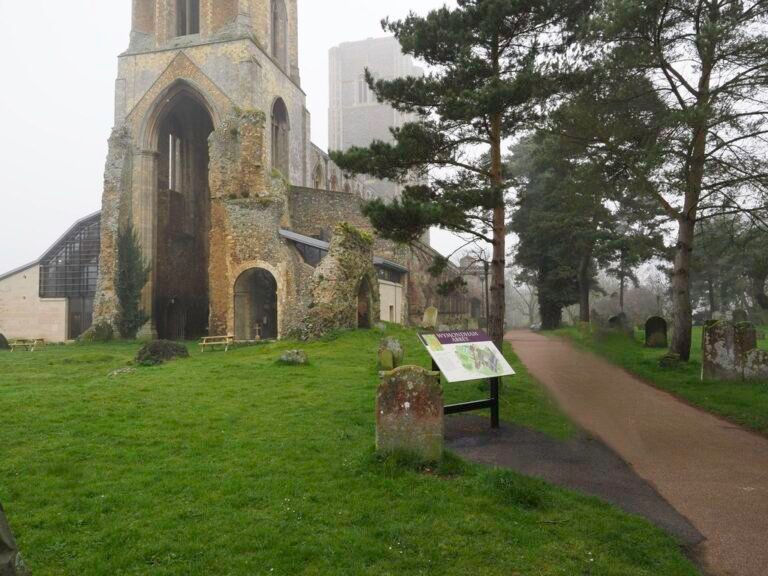
The charter market runs on Fridays, 8am to 2pm, on the cobbles beside the Market Cross, a timber building put up in 1617 and 1618 after a fire in 1615. Wymondham Abbey was founded in 1107. Wymondham High Academy was rated Good after an inspection on 26 September 2023. Wymondham suits anyone commuting to Norwich or Cambridge who still wants a market town. Buyers who want a small place will find it the least small of the eight.
4. Fakenham: median £257,500
Fakenham is the cheap way to live near the north coast. The hourly Lynx 36 Coastliner bus takes about 25 minutes to Wells-next-the-Sea, where the median sale price in the same year was £415,000, £157,500 more than in Fakenham. Our guide to Norfolk beaches covers where the bus gets you.
The Thursday market runs from 9am to 3pm on the Market Place. Fakenham Racecourse, a National Hunt course, is just south of the town in Hempton. The Museum of Gas and Local History occupies the town’s gasworks on Hempton Road, the only complete town gasworks left in England and Wales. There is no station, and Norwich is about 25 miles away: the First X29 bus runs roughly every 30 minutes and takes about 80 minutes. Fakenham is for people who want the coast within reach and a working town to live in, not for Norwich commuters.
5. Diss: median £263,000
Diss is on the Norwich to London Liverpool Street main line, with Greater Anglia intercity trains every 30 minutes each way. The fastest train reaches Norwich in 17 minutes and London in 1 hour 22 minutes; most London trains take 1 hour 30 to 1 hour 38 minutes. It is the only town on this list on the Liverpool Street line, which makes it the one to look at if you go to London two or three days a week.
The Mere, a six-acre lake, sits in the town centre with Diss Park beside it. The market is on Fridays, with a farmers’ market on the second Saturday of each month, and the Corn Hall of 1854 is now an arts centre. Diss High School remained Good after its inspection in March 2024.
6. Swaffham: median £253,000
Swaffham had the lowest median of the eight, and terraced houses sold for a median of £172,000. The Market Place is large and triangular, with the Buttercross at its centre, presented to the town in 1783 by George Walpole, 3rd Earl of Orford. The town council runs the Saturday charter market, 8am to 2.30pm from April to September and until 2pm in winter.
Howard Carter, who found Tutankhamun’s tomb, spent much of his childhood in Swaffham, and Castle Acre Priory is about 4 miles north. The drawback is distance: Norwich is 31 miles east and King’s Lynn 12 miles west, and there is no station. Swaffham suits buyers who want the most house for the money and work locally or from home.
7. Reepham: median £300,000
Reepham is the smallest town here, with 2,656 residents at the 2021 Census, and the price figure rests on only 41 sales. It has held market town status since a charter of 1277, and the country market still runs on Wednesday mornings, 8am to 11am, at the Bircham Centre on the Market Place.
St Mary’s, the parish church, is joined to St Michael’s, which served Whitwell; a third church, All Saints of Hackford, burned down in 1543 and only part of a wall survives in the churchyard. The Dial House, a 400-year-old building on the Market Place, has eight bedrooms, a Bread Source bakery and café, and the Laid-Back wine bar, which serves pizza from Thursday to Saturday. Reepham High School and College takes pupils to 18. Marriott’s Way, the path on the old railway line between Norwich and Aylsham, runs through the town, and Norwich is 12 miles south-east. There was no Reepham Food Festival in 2026, because the Rotary Club that runs it did not have the volunteers. Reepham suits buyers who want a small place with a school to 18.
8. Downham Market: median £260,000
Downham Market faces west, towards Cambridge and London. It is on the Fen Line, with Great Northern trains to King’s Lynn in 17 minutes, Cambridge in 39 minutes and London King’s Cross in 1 hour 31 minutes on the fastest weekday train and 1 hour 35 to 1 hour 42 on most. Norwich is at the other end of the county.
The market runs on Fridays and Saturdays, 8am to 4pm, on the Town Hall car park. The cast-iron town clock on the Market Place was built by William Cunliffe in 1878, given to the town by James Scott, a draper and grocer, and is Grade II listed. The River Great Ouse runs along the town’s western edge. Downham Market is the one to look at if you work in Cambridge and want a detached house: the detached median was £320,000 on 113 sales.
Still deciding where in Norfolk?
Get the free Norfolk Relocation Pack: all 46 towns we cover on one table, on price, council tax, population, trains and distance to Norwich, plus a week-by-week move checklist. The download appears here as soon as you enter your email.
Unsubscribe any time.
The eight towns side by side
| Town | Median price | Market | Mainline station |
|---|---|---|---|
| Holt | £335,000 (85 sales) | First Sunday, April to December | No; Sheringham, Bittern Line |
| Aylsham | £320,000 (118) | Monday and Friday | No |
| Reepham | £300,000 (41) | Wednesday morning | No |
| Wymondham | £275,750 (278) | Friday | Yes: Norwich 13 min, Cambridge 1h 04 |
| Diss | £263,000 (138) | Friday | Yes: Norwich 17 min, London 1h 22 |
| Downham Market | £260,000 (221) | Friday and Saturday | Yes: Cambridge 39 min, King’s Cross 1h 31 |
| Fakenham | £257,500 (115) | Thursday | No |
| Swaffham | £253,000 (163) | Saturday | No |
Plan the move
How we produced this list
Prices are from HM Land Registry Price Paid Data: standard sales only, 1 July 2025 to 30 June 2026, grouped by the town in each registered address (for Aylsham and Reepham, the locality). They are simple medians, so they will not match the mix-adjusted UK House Price Index. Train times are the fastest and average journeys shown on Trainline’s route pages, checked in September 2026. Market days come from the town councils, South Norfolk Council, Visit North Norfolk and the Holt Sunday Market’s own site; school ratings from Ofsted reports; population from the 2021 Census. See our methodology page for how we source our guides.
Frequently asked questions
What are the best market towns in Norfolk?
For shops, schools and a GP on foot, Aylsham. For trains, Wymondham (Norwich and Cambridge), Diss (London Liverpool Street) or Downham Market (Cambridge and King’s Cross). Holt has the most complete Georgian centre and the highest prices.
Which Norfolk market town is cheapest?
Of these eight, Swaffham, with a median of £253,000 in the year to June 2026, followed by Fakenham at £257,500 and Downham Market at £260,000. Our list of affordable places to live in Norfolk goes further down the price range.
Do Norfolk market towns have good amenities?
Aylsham, Diss and Fakenham each have a supermarket, a GP practice and a secondary school in town. Reepham, the smallest, had 2,656 residents at the 2021 Census and has much less, so check what you would drive for.
Which Norfolk market town is best for families?
Wymondham or Aylsham. Wymondham High Academy was rated Good in September 2023 and Aylsham High School in January 2024; Aylsham High stops at 16. See our guide to the best Norfolk villages for families for places outside the towns.
Which Norfolk market town has the best train connection?
Wymondham for Norwich (13 minutes) and Cambridge (1 hour 4 minutes at best). Diss for London Liverpool Street, 1 hour 22 minutes at best. Downham Market for Cambridge (39 minutes) and King’s Cross (1 hour 31 minutes at best).
Which Norfolk market town has the best market?
Aylsham has the most market days: Monday and Friday, plus a food and craft market on the first Saturday of the month. Downham Market trades on Fridays and Saturdays. Holt has only a monthly Sunday market, April to December.
Which Norfolk market town is best for first-time buyers?
Swaffham, where terraced houses had a median of £172,000, or Downham Market, where the terraced median was £220,000 and there is a direct train to Cambridge and London. Fakenham’s terraced median was £205,000.
Are Norfolk market towns busy at weekends?
Market day is usually the busiest: Thursday in Fakenham, Friday in Wymondham and Diss, Saturday in Swaffham. Visit on an ordinary weekday too, because that is what the town is like most of the week.
Data sources: HM Land Registry Price Paid Data, ONS Census 2021, Ofsted, Trainline, town councils. Prices for the 12 months to June 2026. Author: James Ward, Property and Money Editor.
Last reviewed
Planning a move to Norfolk?
Our guides to hiring the firms a move needs.
We earn no commission on these links. Paid placements are sold separately and always labelled. See our advertising and disclosure page.