All area guides

Living near the Norfolk Broads
Choosing where to live near the Broads is mostly a choice between villages with a railway station and villages without one. Prices differ widely between them too.

Choosing where to live near the Broads is mostly a choice between villages with a railway station and villages without one. From Brundall the train reaches Norwich in 11 or 12 minutes, from Hoveton and Wroxham in 16 and from Acle in 21. Everywhere else, from Horning and Ludham to Stalham and Potter Heigham, means driving. The price spread is wide as well: the median sale in the 12 months to June 2026 was £400,000 in Wroxham and Hoveton and £219,500 in Stalham.
Where it is: the Broads villages in this guide are between about 6 and 14 miles east, north-east and south-east of Norwich city centre as the crow flies, in Broadland, North Norfolk and South Norfolk districts, with postcodes NR12, NR13, NR14 and NR29. Inside the Broads area itself, planning decisions are made by the Broads Authority rather than the district council.
Prices by village
These are HM Land Registry figures for standard sales between July 2025 and June 2026, grouped by the village named in the registered address. Several of the samples are small, and the last few months are still being registered, so treat them as a guide to where each village sits, not as a valuation.
| Village | Sales | Median price | Detached median |
|---|---|---|---|
| Wroxham and Hoveton | 61 | £400,000 | £475,000 |
| Horning | 18 | £375,000 | £451,500 |
| Brundall | 70 | £325,000 | £375,000 |
| Ludham | 21 | £320,000 | £372,000 |
| Loddon | 47 | £270,000 | £412,500 |
| Acle | 44 | £263,750 | £303,500 |
| Potter Heigham | 22 | £232,500 | £280,000 |
| Stalham | 34 | £219,500 | £370,000 |
Across those nine villages (Wroxham and Hoveton share a row) the median of 317 sales was £300,000. Land Registry does not record whether a house has river frontage or a mooring, so there is no official figure for waterside homes; the detached medians are the nearest guide to what a family house costs in each place. Secondary schools for the area are Broadland High Ormiston Academy in Hoveton, Acle Academy, Stalham High School and Hobart High School in Loddon, and the individual town guides give each one’s current Ofsted position.
Shops, doctors and hospitals
There is no single centre. Each of the larger villages covers the weekly shop for its own corner of the Broads: Stalham has a Tesco superstore on Old Market Road, Acle an East of England Co-op on Norwich Road, Loddon a Central Co-op on Church Plain and Brundall two Co-ops on The Street. In Hoveton, across the bridge from Wroxham, Roys runs a food hall and a department store along the main street. The business started in Coltishall in 1895 and has advertised itself as the world’s largest village store since the 1930s. For anything bigger the choice is Norwich or Great Yarmouth.
Hoveton, Stalham, Acle, Loddon and Brundall each have a GP practice. For hospital care the western Broads look to the Norfolk and Norwich University Hospital and the eastern side to the James Paget University Hospital in Gorleston-on-Sea, so which one you use depends on where you settle.
The villages on the main boating routes change with the season. Horning, Potter Heigham and Wroxham fill with hire boats and day visitors in summer, and the pubs, tea rooms and boatyards take most of their year’s trade then. From October the rivers empty and the car parks and pubs go back to residents until spring. A house that seems quiet on a November viewing can have a queue of boats outside it in August.
Thinking about moving to the Norfolk Broads?
Get the free Norfolk Relocation Pack: the Norfolk Broads and the other 45 towns we cover on one table, on price, council tax, population, trains and distance to Norwich, plus a week-by-week move checklist. The download appears here as soon as you enter your email.
Unsubscribe any time.
Wildlife, sailing and pubs
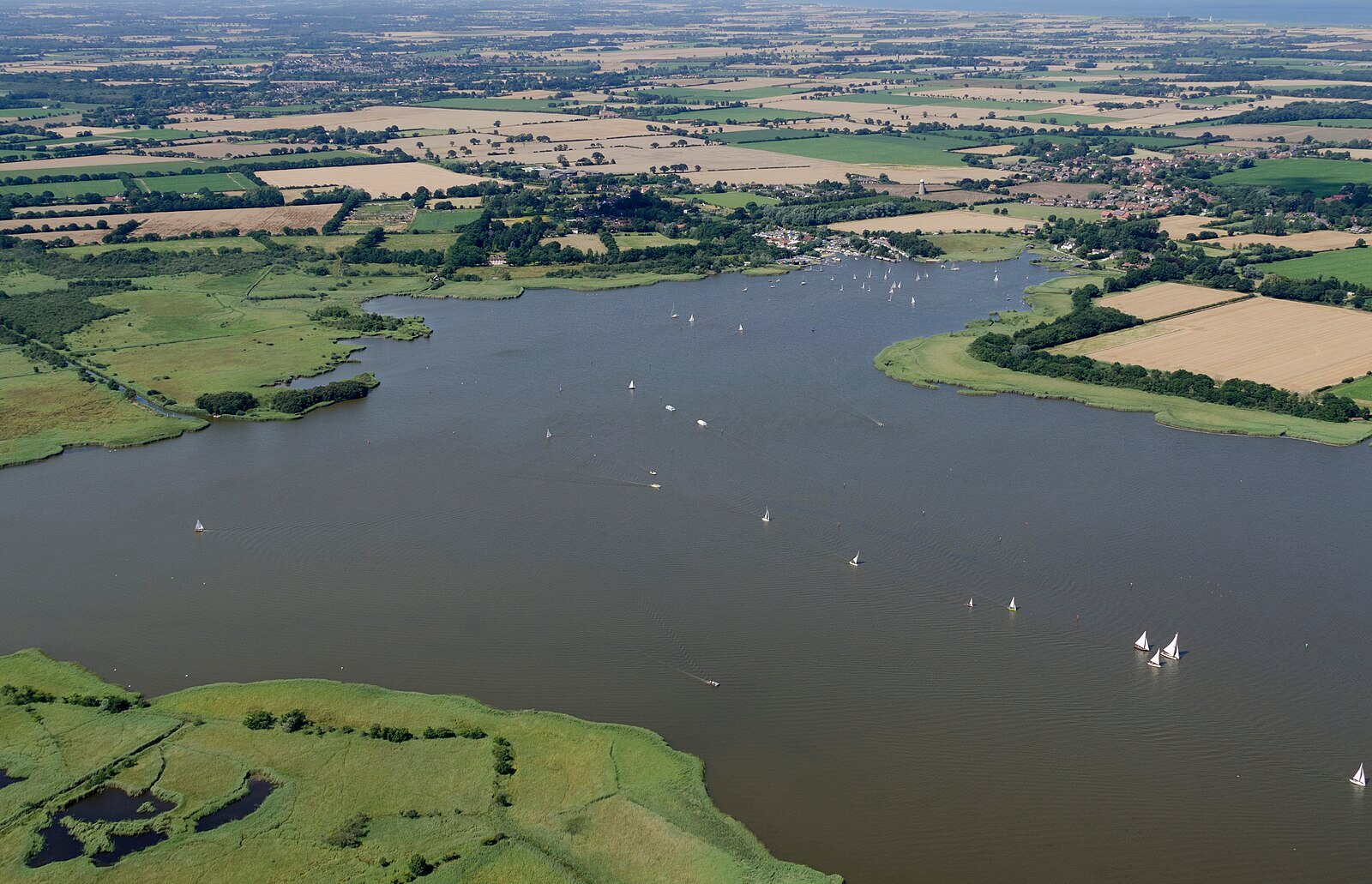
The Norfolk Wildlife Trust runs a floating visitor centre on Ranworth Broad and manages Hickling Broad, a National Nature Reserve, and How Hill near Ludham is another centre for walks and wildlife. Marsh harriers, bitterns and bearded tits breed in the reedbeds. Several of the riverside pubs can be reached by boat as well as by road, among them the Pleasure Boat Inn at Hickling, the Fur and Feather at Woodbastwick and the King’s Head at Hoveton.
Clubs and volunteering
The sailing clubs are the obvious way in for newcomers. The Norfolk Broads Yacht Club races on Wroxham Broad, and Horning Sailing Club and Hickling Broad Sailing Club run racing, social events and junior training. The RSPB, the Norfolk Wildlife Trust and the Broads Authority all run volunteer groups that cut reed, manage habitat and survey wildlife, which is useful work and a quick way to meet people who know the area.
The villages that function as year-round places, Loddon, Stalham, Acle and Brundall among them, have parish councils, village halls and events that run through the winter. In Horning and Potter Heigham the summer population swings much further.
Who decides planning
The Broads have had status equivalent to a national park since the Norfolk and Suffolk Broads Act 1988, and the Broads Authority, which began work in 1989, is both the planning authority and the navigation authority inside its boundary. That boundary is drawn tightly around the floodplain, so plenty of houses in Broads villages sit outside it and their planning applications go to the district council instead. Wroxham and Brundall straddle the line, which is why their neighbourhood plans were adopted by both the Broads Authority and Broadland District Council.
Check which side of the boundary a house is on before you buy. Inside it, extensions, new buildings and changes of use near the water get closer scrutiny, and permitted development rights are more limited in parts of the area. If you plan to alter a waterside property, ask the Broads Authority for pre-application advice before you commit.
Houseboats, moorings and riverside living
You cannot moor a boat on a quiet reach and live on it. Living aboard needs a residential mooring with planning permission, and there are few of them, at a handful of marinas and boatyards including some in Brundall and near Wroxham. The Broads Authority’s local plan review puts the need at 48 residential moorings and would allow new ones only in a marina, mooring basin or boatyard within or next to a village development boundary, or within 800 metres of three or more key services. On top of the mooring rent you pay the Broads Authority navigation toll, which is set each year and depends on the boat’s length and power, and council tax, which the district council collects on residential moorings. You will also need arrangements for waste, fresh water and post.
Buying a house or bungalow with river frontage is the more usual way to live on the water, and the mooring is the detail to get right. A mooring right attached to the freehold is secure. A leased or licensed mooring can be withdrawn or repriced, so read the terms before you exchange. Some of the more remote properties drain to a private septic tank, which has to meet the Environment Agency’s general binding rules for small sewage discharges and needs regular emptying and maintenance.
Flood risk and insurance
The Broads Authority’s local plan puts 82.5% of its area in Flood Zone 3, the highest-risk category on the Environment Agency’s planning map. Any house inside the boundary needs a flood check, and so does any house near the water outside it. Look up the postcode on the Environment Agency’s long-term flood risk service, and if the property is in Flood Zone 3, get insurance quotes before exchanging contracts, not after. Flood Re, the government-backed scheme that keeps premiums affordable, covers most homes built before 2009. Homes built since then in high-risk zones are outside it and can cost much more to insure.
Who should buy where
If you commute to Norwich, buy in Brundall or Wroxham and Hoveton. Brundall has the quickest train and its median was £75,000 lower; Wroxham and Hoveton have Roys, a GP practice and a high school as well as the station, and the highest prices on the table. Acle has a station and a median of £263,750, but an hourly train for most of the day. Stalham has a Tesco and a GP and the lowest median, but no station, so it suits people who drive or who have stopped commuting. Anyone who wants the Broads without the summer crowds should look at the southern villages around Loddon before Horning or Potter Heigham. And anyone buying on the water should treat the flood map and the mooring deeds as the survey that matters most.
Questions and answers
Can you live on a houseboat in the Norfolk Broads?
Yes, but only on a residential mooring with planning permission from the Broads Authority, and there are few of them. An ordinary leisure mooring does not allow living aboard. You also pay the navigation toll and council tax.
Are Norfolk Broads properties at risk of flooding?
Many are. The Broads Authority puts 82.5% of its area in Flood Zone 3. Check the Environment Agency’s long-term flood risk service for the postcode and get insurance quotes before exchange; Flood Re covers most homes built before 2009.
What is the best village to live in near the Broads?
For a Norwich commute, Brundall, which is 12 minutes by train. Wroxham and Hoveton have the most shops and the highest prices, Stalham is the cheapest of the larger villages, and Loddon is the pick for the quieter southern Broads.
Is the Norfolk Broads a National Park?
It is not formally one. It has had equivalent status since the Norfolk and Suffolk Broads Act 1988. The Broads Authority, working since 1989, is the planning and navigation authority inside its boundary and has the same landscape protection powers as a national park authority.
How much do waterside properties cost in the Broads?
There is no official figure, because Land Registry does not record river frontage. The median detached house sold for £475,000 in Wroxham and Hoveton, £451,500 in Horning and £280,000 in Potter Heigham in the 12 months to June 2026; the mooring, the frontage and the flood position move any individual price.
Is it easy to commute from the Broads to Norwich?
From villages with a station, yes: Brundall is 11 or 12 minutes by train, Wroxham 16 and Acle 21, and by car Brundall and Wroxham are each around 20 minutes. From the villages further north and east there is no railway, and the drive is typically 30 to 45 minutes.
Data sources
HM Land Registry Price Paid Data; the Broads Authority; the Environment Agency; Flood Re; Greater Anglia timetables via traintimes.org.uk. See our methodology page for how we research guides.
Related guides
- Living in Wroxham, Norfolk
- Living in Acle, Norfolk
- Living in Stalham, Norfolk
- Living in Brundall, Norfolk
- Living in Loddon, Norfolk
Plan the move
How we produced this guide
Village prices are from HM Land Registry Price Paid Data, standard sales only, for 1 July 2025 to 30 June 2026, grouped by the locality in each registered address; Wroxham and Hoveton are combined. Train times are from the Greater Anglia timetable for Monday 28 September 2026, read on traintimes.org.uk. Drive times are typical times on the main roads. Planning, mooring and flood-zone figures are from Broads Authority local plan documents, and insurance details from Flood Re. We update this guide quarterly. See our methodology page for source links.
Data sources: HM Land Registry Price Paid Data, Broads Authority, Environment Agency, Flood Re, Greater Anglia (Wherry Line and Bittern Line) timetables. Period covered: 12 months to June 2026. Author: Sarah Ellis, Coast and Lifestyle Editor.
Last reviewed
Planning a move to Norfolk?
Our guides to hiring the firms a move needs.
We earn no commission on these links. Paid placements are sold separately and always labelled. See our advertising and disclosure page.