All practical guides
Getting around Norfolk: trains, buses and roads
Norwich and Diss have half-hourly trains to London Liverpool Street and King's Lynn runs direct to King's Cross. Elsewhere the day starts with a drive or a bus, and there is no motorway.

Fastest weekday rail journey times, September 2026
Fastest direct weekday train, with the range most trains take in brackets. Sources: Greater Anglia and Great Northern timetables, via Greater Anglia, Trainline and traintimes.org.uk, September and October 2026.
Where you live in Norfolk decides whether you can get anywhere without a car. Norwich and Diss have trains to London Liverpool Street every half hour, King’s Lynn and Downham Market have direct trains to King’s Cross, and a handful of towns sit on the branch lines. Everywhere else, the day starts with a drive or a bus, on roads that include no motorway at all.
Trains
Greater Anglia runs most of Norfolk’s trains. The exception is the line from King’s Lynn and Downham Market to London King’s Cross via Cambridge, which is Great Northern.
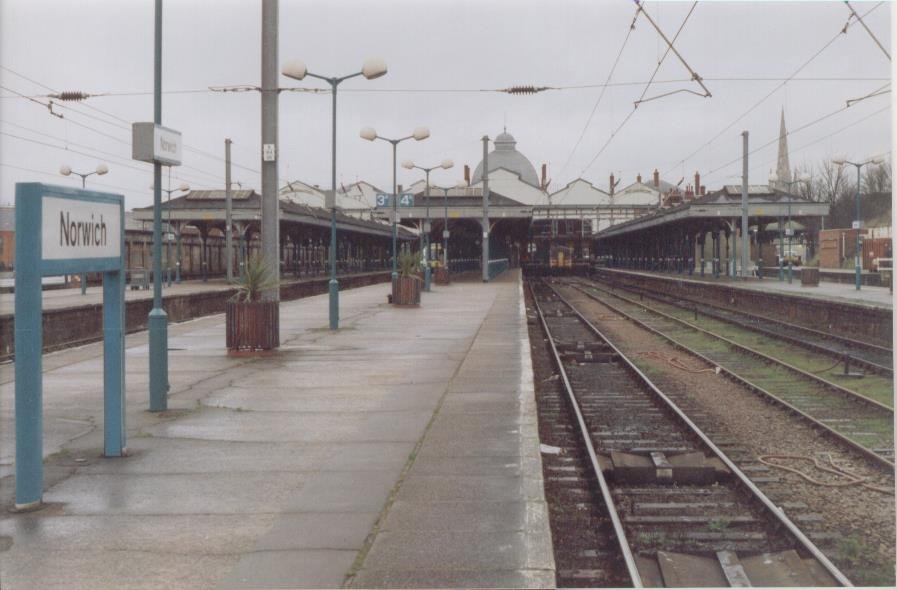
The main line runs from Norwich to London Liverpool Street through Diss, Ipswich and Colchester. Greater Anglia shows 33 trains each weekday, the first at 05:00 and the last at 22:02, and the fastest takes 1 hour 39 minutes, with most taking about 1 hour 50, so none of the current timetable meets the old “Norwich in 90” target. The last train home leaves Liverpool Street at 23:30 and reaches Norwich at 01:33. Diss is on the same trains, every 30 minutes each way, and cuts the journey to 1 hour 22 minutes at best; most take 1 hour 30 to 1 hour 38.
Fares follow the distance. On 29 September 2026 an Anytime Return to Liverpool Street cost £143.70 from Norwich and £131.40 from Diss. Advance fares on Trainline are cheaper for fixed journeys; regular commuters should price a season ticket from Greater Anglia for their own station before comparing house prices.
King’s Lynn’s Great Northern trains run half-hourly until 08:41 and hourly after that. The fastest train takes 1 hour 47 minutes to King’s Cross and most 1 hour 51 to 1 hour 58; the return is 1 hour 45 minutes in the daytime, and the last direct train leaves King’s Cross at 22:48. Cambridge is 55 minutes from King’s Lynn. Downham Market, one stop south, is 39 minutes from Cambridge and 1 hour 31 minutes from King’s Cross on the fastest train.
The Breckland line runs hourly from Norwich to Cambridge through Wymondham, Attleborough and Thetford. Wymondham is 13 to 16 minutes from Norwich and 1 hour 4 minutes from Cambridge on the fastest train, but has no direct London train. Thetford is 43 minutes from Cambridge at best, and East Midlands Railway trains also call there on the way to Nottingham, Sheffield and Liverpool.
Two branch lines leave Norwich. The Bittern Line runs north and reaches Cromer in 44 to 47 minutes and Sheringham in 57 to 66 minutes, roughly hourly, calling at Hoveton & Wroxham and North Walsham on the way; the last train out of Norwich is at 22:47 from Monday to Thursday. The Wherry Lines go to Great Yarmouth, 27 minutes on the fastest train and about 32 on most, and to Lowestoft. At Sheringham the North Norfolk Railway, a heritage steam line, runs 5.25 miles to Holt. It is a tourist attraction and no use for commuting.
| Route | Journey time | How often |
|---|---|---|
| Norwich to London Liverpool St | 1h 39m fastest, most trains about 1h 50m | 33 trains a weekday |
| King’s Lynn to London King’s Cross | 1h 47m fastest, most trains 1h 51m to 1h 58m | Half-hourly to 08:41, then hourly |
| Wymondham to Norwich | 13 to 16 min | About 22 trains a weekday |
| Diss to London Liverpool St | 1h 22m fastest, most trains 1h 30m to 1h 38m | Every 30 minutes |
| Norwich to Sheringham | 57 to 66 min | Roughly hourly |
| Norwich to Great Yarmouth | 27 min fastest, most trains about 32 min | Direct, Greater Anglia |
Buses
Four operators run the main routes. First Eastern Counties runs Norwich’s city network as colour-coded lines (Pink, Green, Purple, Red, Yellow and others) and the X1 from Norwich to Great Yarmouth, Gorleston and Lowestoft, which runs every 30 minutes in the day. Central Connect (formerly Konectbus) runs the mid-Norfolk routes out of Norwich: the 8 to Dereham every 30 minutes, the 6 to Wymondham and Watton hourly, the 10 to Wroxham and Stalham hourly, and the 82 to Diss. Sanders Coaches covers north Norfolk, including the X40, X41, X44 and 44A from Norwich through Aylsham to Cromer, Sheringham and Holt, and the Coasthopper: the CH1 from Cromer to Blakeney and Wells-next-the-Sea, and the CH2 from Cromer to Mundesley and North Walsham. Lynx runs King’s Lynn and the west, including the 34 to Hunstanton every 30 minutes and the Coastliner 36 hourly along the coast to Wells and Fakenham.
Longer routes fill some gaps. First’s Excel runs roughly every half hour from Peterborough through King’s Lynn, Swaffham and Dereham to Norwich, and National Express runs a daily coach from Norwich to London Victoria via Cambridge, the 491, with extra journeys via Thetford on Fridays and at weekends.
Outside those corridors, check the timetable before you look at a house. On weekdays the Green Line 15’s last bus from Norwich to Blofield leaves at 18:45, the last Purple Line bus to Mulbarton leaves just before 19:00, the Central Connect 64 makes one journey a day each way between Harleston and Norwich, and the Central Connect 10 to Stalham ran no journeys at all on Sunday 27 September 2026.
Norwich has six park-and-ride sites: Airport, Costessey, Harford, Postwick, Sprowston and Thickthorn. Parking is free, buses run every 10 to 20 minutes, and a single journey costs £3 for an adult, or £5 for a group of up to five.
Moving to Norfolk this year?
Get the free Norfolk Relocation Pack: all 46 towns we cover on one table, on price, council tax, population, trains and distance to Norwich, plus a week-by-week move checklist. The download appears here as soon as you enter your email.
Unsubscribe any time.
Driving
Norfolk has no motorway. The A11 has been dual carriageway all the way from Norwich to the M11 since the Fiveways to Thetford section opened in December 2014, and it is the fastest road south. Norwich to London typically takes 2.5 to 3 hours by car.
The A47, from Great Yarmouth through Norwich and King’s Lynn to Peterborough, is the east-west road, and it is mid-upgrade. National Highways opened 2.6 miles of new dual carriageway between Blofield and North Burlingham on 6 May 2026. About five miles of dual carriageway between North Tuddenham and Easton, east of Dereham, is due to finish in the 2026-27 financial year, with overnight lane closures until then. The Acle Straight, the single-carriageway stretch between Acle and Great Yarmouth, has no funding for dualling.
North of Norwich, the Broadland Northway (A1270) runs round the city from the A47 at Postwick, past the airport. The A140 runs north to Aylsham and Cromer and south towards Ipswich; the Long Stratton bypass opened to traffic in August 2025, taking through traffic out of the village. The A149 follows the coast from King’s Lynn through Hunstanton, Sheringham and Cromer to Great Yarmouth.
Cycling
Marriott’s Way runs 26 miles from Norwich to Aylsham along old railway lines and is open to walkers, cyclists and horse riders. The Bure Valley Path follows the narrow-gauge railway for 9 miles between Wroxham and Aylsham. Weavers’ Way, a 61-mile path from Cromer to Great Yarmouth, uses the old railway trackbed for much of its length.
In Norwich, Beryl runs a hire scheme of pedal bikes, e-bikes and e-scooters from 193 bays, unlocked through its app.
Norwich Airport
Norwich Airport is in Hellesdon, 2.5 miles north of the city centre, and has its own park-and-ride site. KLM flies to Amsterdam, which the airport says connects to more than 150 onward destinations. Loganair flies to Aberdeen and Jersey, and Ryanair and TUI run holiday routes to places including Alicante, Faro, Malta and Crete. For a wider choice of flights, Stansted is down the A11 and M11.
Frequently asked questions
Does Norfolk have good public transport?
In Norwich and along the railway lines, yes: Norwich has trains to London every half hour and a city bus network. The Bittern Line serves the north-east coast and the Wherry Lines serve Great Yarmouth and Lowestoft. In rural areas buses can stop before 7pm, and some routes run once a day or not on Sundays.
Is there a motorway near Norfolk?
No. The nearest is the M11, reached by the A11, which is dual carriageway all the way from Norwich. The other main roads are the A47 east to west, the A140 north and south of Norwich and the A149 along the coast; long stretches of all three are single carriageway.
Can you live in Norfolk without a car?
In Norwich, yes. In towns with stations, such as Diss, Wymondham, Downham Market, Cromer and Sheringham, it is possible with planning. In most villages you will need a car.
How long does it take to get from Norwich to London?
By train, 1 hour 39 minutes to Liverpool Street on the fastest service and about 1 hour 50 on most. By car, typically 2.5 to 3 hours via the A11 and M11.
Related guides
- Living in Norwich, Norfolk
- Living in King’s Lynn, Norfolk
- Living in Great Yarmouth, Norfolk
- Moving to Norfolk: The Complete Checklist
- Norwich vs King’s Lynn
- Commuting from Norfolk to London and Cambridge
Plan the move
How we produced this guide
Train times and frequencies are from Greater Anglia’s journey planner and May 2026 Bittern Line timetable, Great Northern’s weekday timetable as shown on traintimes.org.uk, and Trainline’s route pages, checked in September 2026; fares are Anytime Returns for 29 September 2026. Bus routes and times are from the timetables on bustimes.org for weekdays in late September 2026, and park-and-ride fares from Travel Norfolk. Road schemes are from National Highways, Norfolk County Council and South Norfolk Council. Drive times to London are typical times on the main roads. We update this guide quarterly. See our methodology page for source links.
Data sources: Greater Anglia, Great Northern, bustimes.org, Travel Norfolk, National Highways, Norfolk County Council. Timetables checked September 2026. Author: Tom Fletcher, Property and Transport Editor.
Last reviewed
Planning a move to Norfolk?
Our guides to hiring the firms a move needs.
We earn no commission on these links. Paid placements are sold separately and always labelled. See our advertising and disclosure page.