All practical guides

Mobile signal in Norfolk: indoor 4G and 5G coverage by district
Outdoors, almost every address in Norfolk gets 4G. Indoors it is patchier: in North Norfolk and South Norfolk fewer than two in three premises had indoor 4G from all four operators.

Outdoors, almost every address in Norfolk gets 4G. The problem is indoors. In Ofcom’s July 2025 figures, 97% of premises in Norwich had indoor 4G from all four mobile operators; in North Norfolk and South Norfolk it was fewer than two in three. If you are buying outside the city, test the signal inside the house, and check the broadband, because Wi-Fi calling is the usual fix.
Indoor 4G from all four operators, share of premises
Share of premises with indoor 4G from EE, O2, Three and Vodafone. Source: Ofcom Connected Nations 2025, local authority data, July 2025.
What Ofcom’s figures show
Ofcom publishes coverage for every local authority in its Connected Nations report. The 2025 report came out on 19 November 2025 and uses July 2025 data. Outdoors, every Norfolk district has 4G from at least one operator at virtually every address, and from all four operators at more than 92% of premises. Indoors the gap opens. Across England, 89% of premises get indoor 4G from all four operators; in rural England it is 56.9%.
The table shows the other measures for each district. The first column is the one to take seriously: the share of premises where no operator reaches indoors at all.
| District (towns) | No indoor 4G from any operator | Outdoor 4G from all four | Outdoor 5G from at least one |
|---|---|---|---|
| North Norfolk (Cromer, Sheringham, Fakenham) | 3.0% | 93.0% | 83.8% |
| South Norfolk (Wymondham, Diss) | 2.3% | 92.3% | 90.4% |
| Breckland (Dereham, Thetford, Attleborough) | 1.2% | 96.6% | 81.0% |
| Broadland | 1.0% | 98.1% | 90.9% |
| King’s Lynn and West Norfolk (Hunstanton) | 0.7% | 98.9% | 86.0% |
| Great Yarmouth | 0.1% | 99.0% | 100.0% |
| Norwich | 0% | 100% | 100% |
In North Norfolk, 3% is about 1,800 of the district’s 61,861 premises. The 5G column uses Ofcom’s high-confidence measure; Breckland is the weakest, with no 5G from any operator outside 19% of premises.
District figures hide the difference between a market square and a farmhouse two miles out, so the only figure that matters for a purchase is the one for the address. Ofcom’s coverage checker gives it, for each operator, indoors and outdoors.
Why a strong outdoor signal can fail indoors
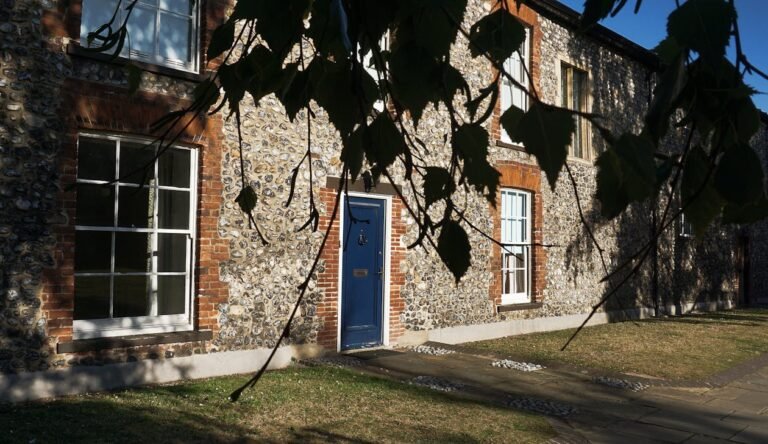
Ofcom lists thick walls, metal window frames and basement rooms among the things that weaken mobile signal inside a building. A lot of older Norfolk housing has solid walls of flint or brick, so a house can show good outdoor coverage on the checker and still have poor signal inside. Ofcom’s advice is to try upstairs or near a window.
Already living in Norfolk?
Get an email when we publish a new guide or something changes that affects Norfolk households. Unsubscribe any time.
Unsubscribe any time.
Choosing a network
No network is best everywhere in the county, so check the postcode on each operator’s own coverage map as well as on Ofcom’s:
- EE: ee.co.uk/why-ee/mobile-network/coverage
- Vodafone: vodafone.co.uk/network/status-checker
- O2: o2.co.uk/coveragechecker
- Three: three.co.uk/support/coverage
Ofcom’s figures for rural England give a rough order. Indoor 4G reached 85.0% of rural premises on EE, 83.6% on Vodafone, 81.3% on O2 and 77.1% on Three in July 2025. Vodafone and Three merged in 2025 to form VodafoneThree and still sell under both names, but their customers now connect to whichever of the two networks has the better signal. If you want two SIMs on different networks as a backup, count Vodafone and Three as one.
If the house turns out to be better served by another network, Ofcom’s rules let you switch mobile provider by text message.
The rural mast programme
The Shared Rural Network was agreed in March 2020 between the government and the four operators. The operators committed £532 million to share masts and close partial not-spots, and the government more than £500 million to build masts in areas with no coverage at all. The headline target was 4G from at least one operator across 95% of the UK’s landmass by the end of 2025. Ofcom’s July 2025 data put it at 95.75%. Norfolk was already there: less than 0.1% of the land in any district had no outdoor 4G.
Fixing weak signal in a house
1. Wi-Fi calling
Wi-Fi calling sends calls and texts over your broadband instead of the mast. It needs a compatible phone and a provider that supports it, and it is switched on in the phone’s settings. For most houses with weak indoor signal it is the first thing to try, and it works only as well as the broadband behind it.
2. Full-fibre broadband
North Norfolk has the weakest indoor mobile coverage in the county and also lags on full fibre: in thinkbroadband’s September 2026 figures, 64.07% of its premises could get it, against 84.39% in Broadland. Before you buy, run the postcode through openreach.com/fibre-broadband to see whether full fibre is available, being built or not planned, and check the other providers’ own postcode checkers too. Our Norfolk broadband guide explains how to read the results.
3. Operator signal boxes and legal repeaters
Some operators supply a small box that plugs into your router and creates a local mobile signal; ask yours whether it still offers one. The other option is an indoor repeater, which amplifies the outside signal. Ofcom made static indoor repeaters for a single operator licence-exempt in 2018, and since May 2022 repeaters that boost more than one operator are allowed too. In both cases the device must meet Ofcom’s technical requirements. Ofcom publishes a list of products it has tested and warns that adverts for illegal repeaters often claim they are approved.
4. A landline, with battery backup
BT plans to retire the old copper landline network by 31 January 2027. After that, home phones run over broadband and stop working in a power cut unless there is a backup. That matters in a house with no mobile signal. Ofcom requires providers to give customers who rely on their landline, including people with no mobile signal at home, a free battery backup that keeps emergency calls working for at least one hour. Tell your provider when you order the line.
Checking signal at a viewing
- Switch your phone to aeroplane mode and back when you walk in, so it reconnects, and note the bars.
- Walk to each main room and the furthest bedroom. The rooms behind the thickest walls are where the signal goes.
- Make a voice call to someone from inside the house. A web page loading does not tell you a call will hold.
- Ask the vendor which network they use and whether they rely on Wi-Fi calling.
- Check the postcode on Ofcom’s coverage checker before you leave, and compare its indoor prediction with what you found.
- Check full-fibre availability at the same postcode. If there is no fibre and no plan for it, Wi-Fi calling will depend on whatever line the house already has.
- Ask the neighbours which network works for them.
Related guides
If you are choosing a village, our list of villages with a working shop and pub is a good starting point. For the coast, read the coastal erosion buyer’s guide, and for the other thing new residents need to sort out early, see our GP registration guide.
Plan the move
How we produced this guide
Coverage figures are from Ofcom’s Connected Nations 2025 mobile data download (local authority and UK and nations files, July 2025 data), which we read directly. Advice on indoor signal, repeaters, switching and landlines is from Ofcom’s consumer guidance; the Shared Rural Network figures are from the government’s 2020 announcement; broadband figures are from thinkbroadband’s district data for September 2026. We checked these on 24 September 2026. See our methodology page for how we work.
Data sources: Ofcom Connected Nations 2025, Ofcom coverage checker, thinkbroadband, GOV.UK. Coverage data July 2025; checked 24 September 2026. Author: Tom Fletcher, Property and Transport Editor.
Last reviewed
Planning a move to Norfolk?
Our guides to hiring the firms a move needs.
We earn no commission on these links. Paid placements are sold separately and always labelled. See our advertising and disclosure page.